



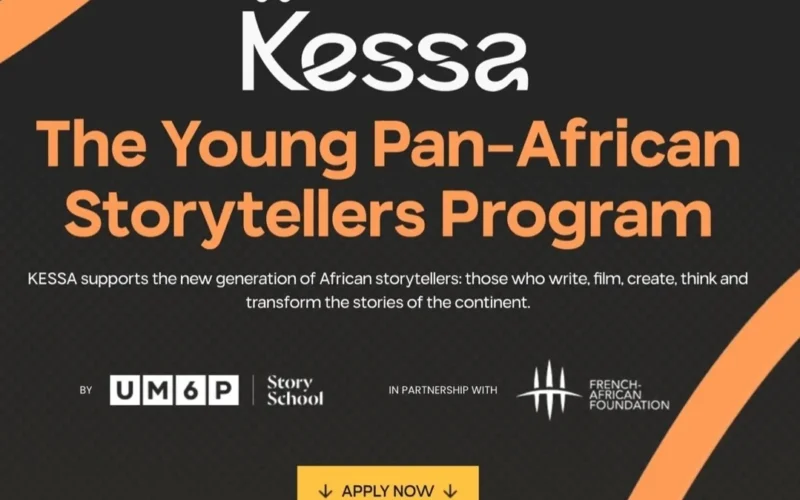
African storytellers have a new reason to update their portfolios. KESSA—The Young Pan-African Storytellers Programme—just opened applications for an all-expenses-paid residency in Morocco that could change how the continent’s stories get told.
The program, launching its first cohort in March 2026, represents something bigger than just another creative workshop. It’s a bet that investing in African storytellers—writers, filmmakers, journalists, scientists, and digital creators—will fundamentally transform how Africa is portrayed globally.
What KESSA Actually Is
KESSA (meaning “story” in Arabic and several African dialects) is a joint initiative between UM6P Story School and the French-African Foundation, designed to support the new generation of African storytellers who write, film, create, think, and transform the continent’s narratives.
The program isn’t subtle about its ambition: “To tell the story of Africa differently is already to transform it.”
This is narrative infrastructure-building disguised as a residency program. And the timing couldn’t be better.
The Morocco Immersive Week: What You Actually Get
From March 23-28, 2026, selected participants will spend six days in Morocco for what KESSA calls “The Immersive Week.” But this isn’t your typical creative retreat with vague promises of “inspiration” and “networking.”
Here’s the actual structure:
Masterclasses covering:
- Storytelling fundamentals
- Writing techniques
- Visual storytelling
- Journalism
- Digital culture
- Scientific narrative
- Narrative leadership
Practical Workshops including:
- Audiovisual production
- 360° storytelling
- Creative identity development
- Collaborative production techniques
Inspiring Encounters with:
- African and international artists
- Journalists and cultural entrepreneurs
- Researchers and creators
- Industry professionals who’ve actually built careers
Co-creation Component:
- Production of an original work (video, podcast, text, or artistic creation)
- Real output, not just ideation
Visibility:
- Pan-African distribution of productions
- Showcasing of talent across the continent
This is structured learning combined with actual production—participants leave with both skills and portfolio pieces.
Who Can Apply (And Who Should)
KESSA is casting a wide net across African creative industries. The program targets three main categories:
Creators:
- Artists
- Directors
- Authors
- Photographers
- Designers
- Performers
Idea Bearers:
- Researchers
- Scientists
- Intellectuals
- Innovators
Media Voices:
- Journalists
- Presenters
- Podcasters
- Producers
But there are specific criteria. Candidates must:
✓ Be between 25 and 40 years old ✓ Demonstrate at least 5 years of experience in their field ✓ Show a creative practice or meaningful narrative work ✓ Have an active and engaged audience related to Africa ✓ Contribute to a positive, structuring, and transformative African narrative ✓ Demonstrate strong potential for impact
That “5 years of experience” requirement is deliberate—KESSA isn’t looking for complete beginners. They want established practitioners ready to level up.
The Application Process
Applications opened December 10, 2025 and close January 10, 2026 at midnight (technically during the night of January 9th).
That’s a tight window—just one month. The message is clear: if you’re serious, you’re already working on your application.
Interested candidates must submit applications online via KESSA’s dedicated platform. While specific application requirements aren’t detailed in the public materials, programs of this caliber typically require:
- Portfolio of previous work
- Statement of purpose
- Description of how participation would impact your practice
- Examples of your engaged audience
- Vision for your co-creation project
Why This Program Matters
Let’s talk about what KESSA is really trying to solve.
African narratives have historically been shaped by external voices—foreign journalists, international NGOs, Western filmmakers. Even well-intentioned coverage often reduces Africa to crisis, poverty, or exotic curiosity. The counter-narrative—Africa rising, innovation hubs, tech ecosystems—is better but often feels like overcorrection rather than nuanced truth.
KESSA’s thesis is simple but powerful: the people best positioned to tell African stories are Africans actively living and shaping those realities.
The program description states: “Africa is a continent of voices, memories, and imaginations. In its cities, on its stages, in its studios, in its laboratories, and in its media, powerful narratives emerge that inspire, challenge perceptions, and showcase an Africa in motion.”
This isn’t about replacing one monolithic narrative with another. It’s about creating the infrastructure for narrative plurality—thousands of African storytellers with the skills, platforms, and networks to tell complex, human, true stories about their contexts.
The Partnership: UM6P Story School + French-African Foundation
The collaboration between UM6P Story School and the French-African Foundation is strategic.
UM6P Story School, part of Mohammed VI Polytechnic University in Morocco, describes itself as “a school of excellence dedicated to storytelling, media, digital technology, and creativity. It trains the voices that will tell the story of the continent’s transformations.”
Morocco has positioned itself as a bridge between Africa, Europe, and the Middle East—geographically, culturally, and economically. UM6P’s investment in narrative training reflects this positioning.
The French-African Foundation describes itself as “a leading organization for the new generation of African and French leaders, committed to cooperation, creativity, and impact.”
The French-African relationship is complicated—colonialism’s legacy, ongoing economic ties, and debates over cultural influence. But the Foundation’s involvement signals an evolution: moving from cultural gatekeeping to capacity building, from defining narratives to funding storytellers who’ll define their own.
What’s Missing (And What We Don’t Know Yet)
Several key details remain unclear:
Funding: Everything is described as “all-expenses-paid,” but what does that actually cover? Flights from anywhere in Africa? Visa support? Per diem? Equipment for productions?
Cohort Size: How many participants will be selected? Is this 10 people or 100? The intimate vs. scalable question matters for networking and learning quality.
Post-Program Support: What happens after March 2026? Is there ongoing mentorship, distribution support, or funding for projects developed during the residency?
Selection Transparency: Who’s on the selection committee? What criteria are weighted most heavily? How do they balance geographic, linguistic, and disciplinary diversity?
Language Requirements: The materials appear in English and French, but what about participants who work primarily in Arabic, Portuguese, Swahili, or other African languages?
These aren’t criticisms—inaugural programs often evolve based on first cohort experiences. But potential applicants should go in with clear questions.
The Bigger Context: Narrative Infrastructure in Africa
KESSA launches into an ecosystem of growing investment in African creative industries:
- Netflix has committed over $175 million to African productions since 2020
- YouTube’s Black Voices Fund has supported hundreds of African creators
- African podcasting, particularly in Kenya, Nigeria, and South Africa, has exploded
- AfCFTA (African Continental Free Trade Area) includes provisions for creative industries
But there’s still a massive gap between raw talent and professional infrastructure. African creators often lack:
- Technical training in global-standard production
- Access to expensive equipment
- Distribution networks beyond local markets
- Legal and business support for IP protection
- Peer networks for collaboration
Programs like KESSA address these gaps directly—not through grants (though funding helps) but through structured capacity building.
Should You Apply?
If you’re reading this and wondering whether KESSA is for you, here’s a quick self-assessment:
Apply if:
- You’ve been creating/writing/filming/reporting for 5+ years
- You have a body of work you’re proud of but know you could level up
- You have an audience—even a modest one—that engages with your work
- You’re frustrated by how African stories are told and want tools to tell them better
- You’re willing to collaborate and co-create rather than working solo
- You can commit fully to a week in Morocco in March 2026
Don’t apply if:
- You’re just starting out (under 5 years experience)
- You’re looking for funding more than skills development
- You work in isolation and aren’t interested in collaboration
- You can’t travel or commit to the full program dates
The program seems designed for mid-career creators at inflection points—people who’ve proven they can create but are ready to professionalize, expand reach, or shift focus.
What This Could Mean Long-Term
If KESSA succeeds—and that’s a big if—it could become a model for creative infrastructure building across Africa.
Imagine cohorts of 20-30 storytellers annually, over a decade. That’s 200-300 trained, networked, empowered creators spanning film, journalism, science communication, digital media, and art. Many will train others. Some will launch media companies. Others will shape policy or lead cultural institutions.
The ripple effects could be substantial: more nuanced African stories in global media, better-equipped newsrooms, stronger creative industries, increased international co-productions, and crucially, more Africans controlling how their stories are told.
Or it could be a great week in Morocco for a few dozen people with limited long-term impact. The difference will come down to execution, ongoing support, and whether subsequent cohorts get funded.
The Application Deadline Is Tight
With applications closing January 10, 2026, potential applicants have less than a month to prepare materials. That’s deliberate—programs that change lives don’t wait for perfect timing.
If you’re an African storyteller who’s been waiting for permission to level up, this might be your signal. UM6P Story School and the French-African Foundation are betting on you. The question is whether you’ll bet on yourself.
Because here’s the truth: Africa’s stories are being told right now, whether African storytellers control those narratives or not. KESSA is offering tools to shift that balance. The only question is who’ll step up to use them.
Apply here: KESSA Application Platform (check Story School website for direct application link)
Application Deadline: January 10, 2026 at midnight (11:59 PM, January 9)
Program Dates: March 23-28, 2026 | Morocco




Comments 1