



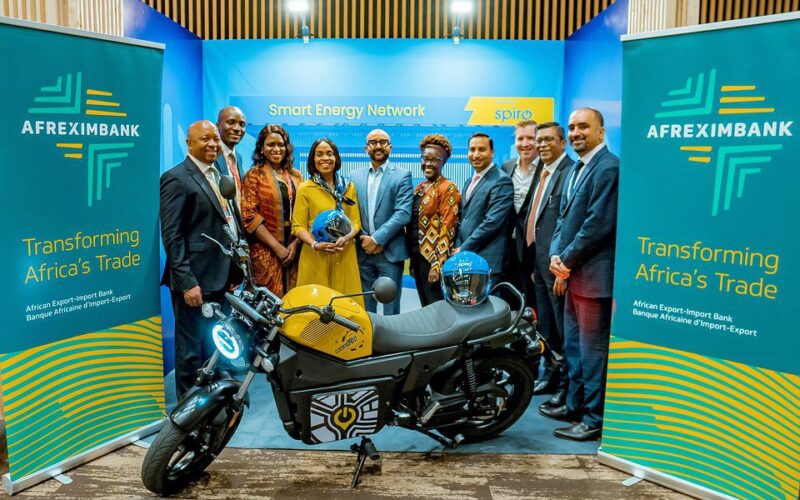
If you’ve walked through parts of Lagos or Nairobi lately, you’ve probably seen them — quiet electric bikes zipping past traffic, distinctive battery packs visible on the back, riders who used to spend 30% of their income on petrol now operating vehicles that cost a fraction to run. They’re mostly Spiro bikes. And the company behind them just raised another $50 million in debt financing to make sure a lot more of those bikes end up on African roads.
The round, announced Monday, was led by the African Export-Import Bank (Afreximbank) with participation from Nithio, a US-based climate fintech, and the Africa Go Green Fund, managed by Cygnum Capital. The funding follows Spiro’s $100 million raise in October 2025 — which, at the time, became Africa’s largest-ever electric mobility investment — meaning the company has now raised over $230 million since its 2022 founding.
That’s an enormous amount of capital for a three-year-old company operating in six African markets. And it’s structured as debt, not equity — which tells you something important about where Spiro is in its lifecycle. The company isn’t burning cash to prove product-market fit anymore. It’s scaling infrastructure. And lenders believe the cash flows from battery swaps are predictable enough to service debt obligations.
Whether that belief holds up as Spiro floods African cities with tens of thousands more electric motorcycles is the question that will determine whether this becomes one of Africa’s defining climate tech success stories — or another cautionary tale about scaling too fast in fragmented, unreliable operating environments.
The Numbers That Matter
Spiro’s traction is real. As of February 2026, the company has:
- 80,000+ electric motorcycles deployed across Kenya, Uganda, Rwanda, Nigeria, Benin, and Togo
- 2,500+ battery-swapping stations operational
- 300,000+ batteries in circulation
- 30 million battery swaps completed to date
- Over 1 billion kilometers logged by riders, carbon-free
In Kenya alone, Spiro sold over 15,000 electric motorcycles in 2025 — capturing 60% market share of new electric motorcycle sales in the country. Kenya registered 25,277 electric motorcycles in 2025, meaning 15.3% of all new motorcycle registrations were electric. That’s not a pilot. That’s a market transformation.
Kenya has over 2 million internal combustion engine motorcycles registered, most of which operate as boda bodas (motorcycle taxis) providing daily transport for millions of people. The total addressable market is massive. And Spiro, as the largest player with the densest swap network, has first-mover advantage.
Kaushik Burman, Spiro’s CEO, framed the funding in infrastructure terms: “With strong financial backing and cutting-edge technology, Spiro is leading Africa’s transition to sustainable mobility. This new funding reinforces our vision of building a robust, scalable energy network tailored for Africa by Africans.”
That framing — “energy network,” not “vehicle company” — is telling. Spiro isn’t really selling bikes. It’s selling energy-as-a-service. Riders buy or lease the motorcycles, but Spiro owns and manages the batteries. Swapping a depleted battery for a charged one at a Spiro station takes under five minutes and costs significantly less than filling a petrol tank. The recurring revenue comes from energy, not hardware. And energy, if managed correctly, is predictable.
Which is exactly why lenders are comfortable extending debt.
The Business Model: Energy-as-a-Service for the Last Mile
Spiro’s model is structurally different from traditional vehicle sales, and understanding that difference is critical to understanding why debt financing makes sense.
Traditional model: You sell a motorcycle to a rider for $1,500. That’s your revenue. The rider owns the bike, buys petrol, maintains it, and bears all operating costs. You have no recurring relationship. You make money on volume and margins.
Spiro’s model: You sell or lease a motorcycle to a rider for significantly less — often with financing options. But you own the batteries. The rider pays a daily or weekly subscription to swap batteries at Spiro stations. That subscription generates recurring revenue for the life of the motorcycle. You make money on energy, not just hardware.
The margins on battery swaps are significantly better than the margins on motorcycle sales. Petrol in Nairobi costs around KSh 200 per liter ($1.50 USD). A typical boda boda rider burns through 4-5 liters per day, spending KSh 800-1,000 daily ($6-$7.50). That’s KSh 24,000-30,000 per month ($180-$225) just on fuel.
Spiro’s battery swap subscription costs a fraction of that. Riders report cutting their fuel costs by 60-70%. The difference goes straight into their pockets — which is why adoption is accelerating. For riders operating on thin margins, saving $100-$150 per month on fuel is life-changing.
For Spiro, the economics work if:
- Batteries stay functional long enough to recoup capital costs
- Swap stations maintain high utilization rates
- Grid electricity costs remain stable
- The ratio of bikes to batteries to swap stations stays balanced
When those variables align, battery swapping is a high-margin, recurring-revenue business. When they don’t — when batteries degrade faster than expected, swap stations sit idle, electricity costs spike, or demand outstrips supply — margins collapse.
And that’s where Spiro’s rapid growth is starting to expose operational limits.
The Growing Pains Nobody Talks About
Spiro controls over 50% of Africa’s electric motorcycle market. In Kenya, it owns 60% market share. That dominance gives it pricing power and network effects. But it also exposes the company to capacity mismatches that smaller players can avoid.
According to industry observers tracking the sector, battery availability at swap stations has become inconsistent as the number of motorcycles on the road has grown faster than battery deployment. The problem manifests in two ways:
First, demand spikes. When Spiro floods a city with 5,000 new bikes in a quarter, those riders immediately start showing up at swap stations. If battery supply hasn’t scaled proportionally, stations run out of charged batteries during peak hours. Riders show up, find no batteries available, and either wait or ride to another station — burning time and reducing their earning potential. That degrades the value proposition.
Second, import delays. Most of Spiro’s batteries are imported, and customs clearance in Kenya (and other markets) is notoriously slow and unpredictable. A shipment of 10,000 batteries that should clear customs in a week can sit for a month. During that month, the bike-to-battery ratio deteriorates, stations run low, and rider satisfaction drops.
These are what the industry politely calls “growing pains.” But they’re the kind of growing pains that, if not managed, can turn a scaling success story into an operational nightmare.
Tom Mower, an analyst tracking Africa’s e-mobility sector, noted that larger networks will eventually stabilize as logistics kinks get worked out and companies use real-time swap station data to allocate batteries dynamically. But the transition period — when you’ve deployed tens of thousands of bikes but haven’t yet built the data systems and supply chains to manage them efficiently — is treacherous.
Spiro is in that transition period right now. And the $50 million in debt is being deployed to close the gap: more batteries, more swap stations, better predictive logistics, and faster expansion into new markets where utilization rates are still low.
The Competitive Landscape: Everyone Wants a Piece
Spiro’s raise comes amid a surge of capital flowing into Africa’s e-mobility sector, signaling that institutional investors believe the sector is reaching commercial viability.
Days before Spiro’s announcement, Arc Ride, another e-mobility firm, secured $5 million in equity from the International Finance Corporation (IFC), the World Bank’s private sector arm. Last week, Gogo Electric, a Ugandan e-bike startup, raised $1 million from ElectriFI, an EU-funded electrification financing facility.
Those are smaller rounds, but the pattern is clear: development finance institutions (DFIs) and climate-focused funds are actively deploying capital into electric two-wheelers. The sector is no longer speculative. It’s commercially validated. And competition is intensifying.
In addition to Arc Ride and Gogo Electric, players like Roam (formerly Opibus), Ampersand, and a growing cohort of Chinese manufacturers are entering or expanding in African markets. Battery swapping, in particular, is attracting attention because it solves the two biggest barriers to EV adoption in Africa: high upfront costs (riders don’t need to buy expensive batteries) and range anxiety (swaps take five minutes, not hours of charging).
But battery swapping only works at density. You need enough swap stations that riders are never more than a few kilometers from one. And you need enough batteries in circulation that stations never run dry during peak hours. That requires massive capital deployment upfront — which is exactly what Spiro’s debt financing is designed to fund.
Laurène Aigrain, Managing Director of the Africa Go Green Fund, described Spiro’s model as “delivering tangible impact across multiple African markets” and said the fund was backing the company because it combines “innovation with measurable environmental and social impact.” That’s development finance speak for: the unit economics work, the impact is real, and we believe the model can scale.
Raghav Sachdeva, CIO of Nithio, was more direct: Spiro has “demonstrated that electric mobility can scale rapidly while delivering real economic value to riders and meaningful emissions reductions.”
The question is whether that scaling can continue without hitting infrastructure constraints that break the model.
The Debt Strategy: Why Spiro Isn’t Raising Equity
Spiro’s decision to raise $50 million in debt rather than equity is strategically significant.
Debt is cheaper than equity if your business generates predictable cash flows. You pay interest, but you don’t dilute ownership. For a company like Spiro, which operates a subscription model with recurring revenue from battery swaps, debt makes sense — assuming utilization rates stay high and operational costs stay under control.
Equity, by contrast, is appropriate when your business is still proving product-market fit, cash flows are unpredictable, and investors are betting on future growth rather than current profitability. Spiro is past that stage. The company has 80,000 bikes on the road generating recurring revenue. Lenders can model those cash flows and underwrite debt accordingly.
Afreximbank, as the lead investor, brings more than just capital. As Africa’s premier export-import bank, Afreximbank has deep relationships with governments, utilities, and regulators across the continent. That access matters enormously when you’re trying to scale infrastructure that requires grid connections, import licenses, and regulatory approvals in six different countries.
Oluranti Doherty, Managing Director of Export Development at Afreximbank, framed the investment in industrial policy terms: “Driving Africa’s transition to electric mobility is central to how we view sustainable economic development across the continent. By supporting Spiro, Afreximbank is committed to financing the future of sustainable African trade; we are promoting a green industrial value chain that keeps innovation at the forefront of a just energy transition.”
Translation: Afreximbank sees Spiro as part of a broader strategy to reduce Africa’s dependence on imported fossil fuels, create green industrial value chains, and position the continent as a player in the global clean energy economy. That’s a developmental mandate, not just a commercial one. And it means Spiro has institutional backing that goes beyond balance sheet analysis.
What the $50 Million Will Actually Fund
Spiro says the new capital will support three priorities:
1. Network expansion: More battery-swapping stations across existing markets (Kenya, Uganda, Rwanda, Nigeria, Benin, Togo) and entry into new markets where trials are already underway (Cameroon, Tanzania).
2. Technology advancement: Automated battery swaps (reducing station labor costs), fast-charging infrastructure (reducing turnaround time between swaps), and renewable energy integration (solar-powered swap stations that reduce grid dependence).
3. Manufacturing scale-up: Spiro has assembly and production facilities in Nigeria, Kenya, Uganda, and Rwanda. The company is vertically integrating to reduce reliance on imported components and bring costs down.
That third priority is particularly important. Right now, most of Spiro’s bikes and batteries are assembled locally but rely on imported components — motors, battery cells, control systems. As long as Spiro depends on imports, it’s exposed to customs delays, currency fluctuations, and supply chain disruptions.
Local manufacturing solves that. But it requires massive upfront capital investment in tooling, facilities, and skilled labor. The $50 million debt, combined with the $100 million raised in October, gives Spiro the runway to build that capacity.
Gagan Gupta, Spiro’s founder, emphasized the infrastructure dimension: “We will use it to deploy energy infrastructure that will contribute meaningfully to a greener future in Africa.”
That’s aspirational language. But it’s also accurate. Spiro is building what amounts to a parallel energy distribution network for two-wheeled transport. If it works, the model could extend beyond motorcycles to three-wheelers, delivery vans, and eventually passenger vehicles. Battery swapping as infrastructure, not just as a service.
The Risks That Could Break the Model
For all of Spiro’s traction, the business model carries structural risks that debt financing amplifies rather than mitigates.
First, grid reliability. Battery swapping depends on consistent grid electricity to charge batteries at swap stations. In Kenya, grid reliability has improved significantly, but outages still happen. In Nigeria, grid reliability is worse. If swap stations can’t charge batteries reliably, the entire system breaks.
Spiro is addressing this by integrating solar power and battery storage into swap stations, creating mini-grids that can operate independently. But that adds cost and complexity.
Second, battery degradation. Lithium-ion batteries lose capacity over time. After 500-1,000 charge cycles, a battery that once held 100% charge might only hold 80%. That means riders get less range per swap, swap frequency increases, and utilization rates at stations rise — potentially faster than Spiro can deploy new batteries.
Managing battery lifecycle costs is critical. If batteries degrade faster than expected, Spiro’s unit economics deteriorate. And because the company owns the batteries (riders don’t), that cost sits entirely on Spiro’s balance sheet.
Third, competitive pressure. Spiro dominates today, but Chinese manufacturers are flooding African markets with cheap electric motorcycles that riders can buy outright without subscriptions. If a rider can buy a bike for $1,200 and charge it at home for pennies, why would they pay a daily swap fee?
Spiro’s answer: convenience, reliability, and network density. But that only holds if the swap network stays dense, batteries stay available, and riders perceive the subscription as better value than ownership. The moment that equation flips, Spiro’s market share is at risk.
Fourth, debt obligations. Unlike equity, debt has to be repaid. If Spiro’s cash flows dip — because utilization rates drop, competition intensifies, or operational costs spike — the company still owes its lenders. That’s fine in a growth market. It’s dangerous in a downturn.
The Verdict: Scaling Fast, But Fragile
Spiro’s $50 million debt raise is a bet that Africa’s electric two-wheeler market is reaching escape velocity. The company has deployed 80,000 bikes, built 2,500 swap stations, completed 30 million swaps, and captured dominant market share in Kenya and Nigeria. Those are real numbers. The infrastructure is working. Riders are adopting.
But the business is also hitting the operational limits of rapid scaling. Battery shortages at swap stations. Import delays. Grid reliability challenges. Competitive pressure. These aren’t existential threats yet. But they’re warning signs that scaling infrastructure-dependent businesses in Africa is brutally hard, even when the product-market fit is clear.
Debt financing makes sense if Spiro’s cash flows stay predictable. And they will — as long as utilization rates stay high, batteries stay available, grid electricity stays affordable, and riders keep choosing Spiro over competitors. That’s a lot of variables that all need to stay aligned.
If they do, Spiro could become the dominant electric mobility platform across Africa, creating a parallel energy distribution network that powers millions of vehicles and reduces dependence on imported fossil fuels. The $230 million raised to date gives it the capital to try.
If they don’t, Spiro will be another well-capitalized infrastructure company that scaled too fast, overestimated its ability to manage operational complexity, and discovered that debt obligations don’t care whether your growth story is compelling — they care whether your cash flows are real.
For now, the momentum is on Spiro’s side. But momentum doesn’t pay back debt. Cash flow does. And the next 18 months will determine whether Spiro has enough of it.





Comments 1