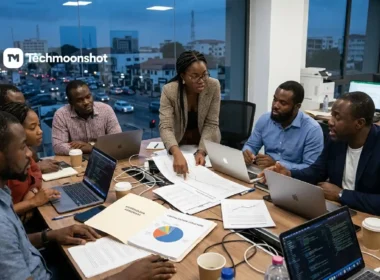
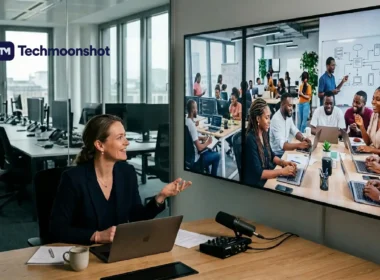

Lagos delivered a second day of sharp, substantive conversation at the Africa Technology Expo 2026. Across the curved, teal-lit main stage, leaders from Glovo, Nokia, LG, NGX Group, Baobab Nigeria and Breet laid out where they believe African convenience, finance and infrastructure are headed next, and the room leaned in for nearly every session.
ATE 2026’s second day kept the energy of opening day going, with headline sponsors Breet and Layer3 anchoring the backdrop alongside gold sponsors MaxiTech and MTN, and supporting partners including Wakanow, Cloudsa and LG. A fireside chat between Iyin Aboyeji and Nnaemeka Clinton also featured on the day’s agenda.
Glovo Makes the Case for Convenience as Nigeria’s New Retail Default
The day opened with “How Convenience Killed Traditional FMCG,” a session pairing Glovo General Manager Reni Onafeko with fellow panellist Seyi Ajadi. Their core argument: on-demand delivery has fundamentally reshaped how Nigerians shop for everyday goods, compressing the distance between a craving and a transaction in ways traditional fast-moving consumer goods retailers are still learning to match.
It is a thesis backed by real momentum. Nigeria’s quick-commerce and food delivery categories have grown rapidly, with players like Chowdeck demonstrating that the model can scale profitably in a famously tough operating environment. Onafeko’s confidence reflects a broader shift TechMoonshot has tracked closely, including Chowdeck’s own pivot into dark-store quick commerce as the category matures beyond meal delivery into a wider retail play.
The open question for the sector now is less about demand and more about trust at scale. As more vendors and platforms compete for the same customer, the operators who pair speed with airtight accountability to the small businesses on their platforms will be the ones who convert convenience into long-term loyalty rather than just transaction volume.
Fintech Leaders Use a Provocative Panel Title to Make the Case for Discipline
“Have Fintechs Lost the Plot?” brought together Afeez Ramoni, Chief Information Officer at Nigerian Exchange Group, Eric Ntumba, CEO and Managing Director of Baobab Nigeria, and Umulkairi Balogun, B2B Product lead at Breet. Rather than treating the provocative title as an attack, the panel used it as a springboard to argue that Nigerian fintech has matured past its hype-driven phase and into a more disciplined era.
Ramoni’s NGX vantage point added useful texture. Nigeria’s regulators have tightened oversight considerably in recent years, from GPS-tracking requirements for point-of-sale terminals to stricter anti-money-laundering compliance expectations, and the panel framed this as healthy maturation rather than a burden. Ntumba’s perspective from Baobab Nigeria, a microfinance institution built around profitability rather than growth-at-all-costs, reinforced the point that sustainable fintech businesses are increasingly the ones setting the pace.
Balogun’s presence representing Breet, one of ATE 2026’s headline sponsors, underscored how confident the sector now feels about scrutinising itself in public. Ghana’s own experience tightening its digital lending market through mandatory licensing came up as a regional comparison, with the panel largely agreeing that regulatory rigour, applied thoughtfully, strengthens rather than stifles the ecosystem.
Nokia and LG Lay Out Africa’s Connected Infrastructure Roadmap
The afternoon turned to hardware and networks. “Understanding Nokia’s Africa Plan” paired Marco Rebecchi, Nokia’s Country Manager for the Middle East, Africa and Nigeria, with Napa Onwusah, Managing Partner and CEO of B4B Partners. Rebecchi described Nokia’s ambition to be a long-term network infrastructure partner across the continent rather than a vendor chasing one-off contracts, a pitch aimed at telecom operators working to extend coverage beyond Nigeria’s major cities.
An LG executive followed with the company’s “Smart Living Vision,” outlining a shift from standalone appliances to AI-powered, app-controlled home ecosystems designed around convenience and wellbeing. Both pitches point toward a genuinely connected future for African consumers and operators alike. Realising that future at scale will depend on the kind of power and connectivity investment TechMoonshot has covered in Lagos’s own infrastructure build-out, including the hyperscale data centre project anchoring the city’s cloud ambitions. The appetite from global hardware and network players is clearly there. The next milestone worth watching is how quickly that appetite translates into infrastructure Nigerians can rely on every day.
Developers Make the Case for Building African Smart Cities the Right Way
The day’s closing panel tackled its subject head-on. “Is There an African Future With Smart Cities? ‘Unlikely,’ Says Developers!” featured Olawale Opayinka, CEO of Makaya Group, alongside Andrew J Cary, Co-Founder and CEO of SNAAP, and a TechCabal Insights consultant. Rather than dismissing the smart city concept outright, the panel used its candour to sketch out what a realistic, sequenced path to smart urban development in Africa actually looks like.
Opayinka’s developer experience grounded the conversation in practical detail: land titling, power reliability and municipal technical capacity all need to mature before sensor-driven city infrastructure can scale. Cary added a financing lens, noting that smart city pilots are easy to launch with grant money but need recurring municipal budget commitments to last. The panel’s honesty is itself a sign of a maturing ecosystem, one willing to separate genuine progress from conference-stage hype.
That same realism extends naturally to questions about data governance, an area where Nigeria has moved fast. The country’s regulators have already shown they take this seriously, collecting billions in penalties through an increasingly assertive data protection enforcement regime. For any future smart city build-out, that kind of regulatory groundwork on data accountability will matter just as much as the sensors themselves.
Two days of ATE 2026, the throughline is encouraging. Whether the conversation is about delivery convenience, fintech discipline, network infrastructure or the long road to smart cities, Lagos’s tech leaders are choosing candour over hype, and that is exactly the kind of conversation an ecosystem this fast-moving needs.