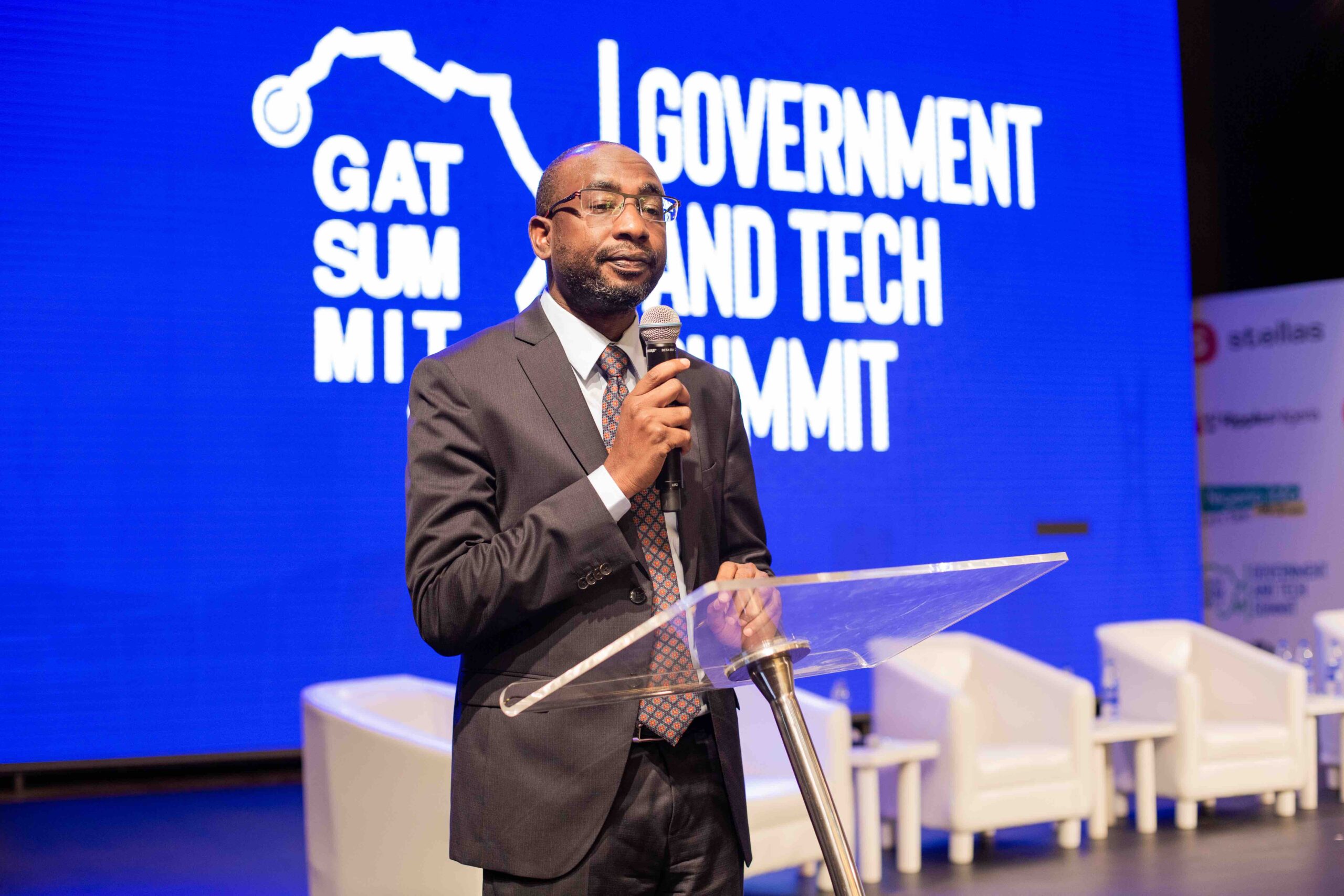
At the Eko Hotel & Suites in Lagos last month, Kazeem Tewogbade stood on stage at Bluechip Technologies’ third Data and AI Summit and said something Nigerian tech rarely gets to say about itself. His company had just bought YarnGPT, a Nigerian-accented text-to-speech model, outright. Not licensed it. Not partnered with it. Bought it, from the Nigerian engineer who built it.
The engineer is Saheed Azeez, who first showed up on the ecosystem’s radar in 2023 as a runner-up at Bluechip’s own hackathon. Two years later, he had a working model that could take a written news article and turn it into something that sounded like a podcast in Yoruba, Igbo, or Hausa. Bluechip had reportedly been trying to build the same thing internally. Tewogbade’s logic, relayed to the summit crowd, was blunt: why start from zero when a working engine already exists.
It is a small transaction by global AI standards. Terms were not disclosed. But it lands at a specific moment for Nigerian AI, one where the government just secured bragging rights and the market is still asking whether any of it converts into durable, locally owned technology companies. Nigeria climbed 42 places in two years to rank 38th globally and first in Africa on the 2026 Global Index on Responsible AI, a jump the Ministry of Communications, Innovation and Digital Economy has been eager to publicise. A separate index, the 2026 Global Outsourcing AI Readiness Index from Ataraxis, ranks Nigerian workers sixth in the world for AI literacy. Its companies, by contrast, score 34 out of 100 on enterprise AI adoption, ahead of only a handful of markets including Ghana and Pakistan.
That gap between individual fluency and institutional capacity is the backdrop against which a small cluster of Nigerian founders has spent the past three years building AI companies that do not wait for the gap to close. Some are solving problems no foreign lab has bothered with: languages, accents, and clinical contexts that global models simply were not trained on. Others are proving that AI products built in Lagos can compete on global benchmarks without a Silicon Valley address.
Nigeria has more than 500 living languages, and almost none of them show up in the training data behind the large language models that now sit underneath most consumer software. Silas Adekunle and Eniola Edun founded Awarri in 2019 to treat that absence as an infrastructure problem rather than a cultural footnote. In November 2023, Awarri opened a data annotation lab in Ikorodu employing more than 100 workers to collect and label speech and text in Nigerian languages, an event significant enough that Minister Bosun Tijani attended the opening himself. By April 2024, the ministry had folded Awarri into a formal partnership with Data.org and the National Information Technology Development Agency to build what officials called Nigeria’s first government-backed, open-source multilingual language model. The payoff arrived in September 2025, when Tijani unveiled N-ATLAS, the Nigerian Atlas for Languages and AI at Scale, on the sidelines of the UN General Assembly in New York. The model understands and generates text in Yoruba, Hausa, Igbo, and Nigerian-accented English, part of the same infrastructure push that has pulled international accelerators toward African-language AI as a serious research category rather than a side project.
Yinka Iyinolakan, Soji Akinlabi, and Shona Olalere are chasing a version of the same problem from a different angle. Their company, the Centre for Digitization of Indigenous African Languages, built Indigenius Mobile, a conversational AI platform the founders say now supports 180 African languages, along with a multilingual keyboard that lets users type in whatever language they actually speak. CDIAL has been at this since 2021, long enough to win a $50,000 prize at Pharrell Williams’ Black Ambition competition in Tribeca in 2023 and to join the inaugural cohort of Accelerate Africa, an accelerator explicitly modelling itself on Y Combinator. Azeez’s YarnGPT sits in the same lane, and its acquisition by a Nigerian company rather than a foreign one is the exception worth flagging. Most homegrown AI tools that reach this stage of maturity get scooped up by outside accelerators or investors long before a local buyer gets the chance.
Voice AI in Nigeria has found its sharpest use case in places where the stakes are literal life and death. Tobi Olatunji and Olakunle Asekun built Intron Health to convert doctors’ speech into structured medical records, but only after concluding that adapting an American-trained speech model to African accents was a dead end. They trained their own from scratch instead. What started as a tool for a handful of Nigerian hospitals has become Sahara, a suite of voice AI products that Intron says now covers 57 languages, built on a dataset of more than 14 million audio clips gathered from over 40,000 speakers across 30 African countries. The company raised $1.6 million in pre-seed funding in 2024, led by Microtraction with Octopus Ventures and Plug and Play Ventures participating, then joined NVIDIA’s Inception programme and struck research partnerships with Google Research and the Gates Foundation. Ogun State’s judiciary now uses Sahara to handle courtroom transcription, a use case that has nothing to do with the hospitals where Intron started.
Charles Onu approached the same clinical-audio problem from the opposite end of the human lifespan. His company, Ubenwa Health, takes its name from the Igbo phrase for a baby’s cry, which is also its product. Onu, a Nigerian computer scientist working out of Montreal’s Mila research institute, and his team found that birth asphyxia, the leading cause of neurological injury at birth, changes the amplitude and frequency of an infant’s cry in ways a trained model can detect long before a doctor would catch it by ear. Ubenwa’s research now runs across six hospitals in three countries, including Enugu State University Teaching Hospital and Rivers State Teaching Hospital in Nigeria alongside partners in Montreal and Brazil. Its $2.5 million pre-seed round was led by Radical Ventures and pulled in individual backers with serious AI pedigree, including Hugo Larochelle and Marc Bellemare from Google Brain and Pieter Abbeel and Richard Socher of AIX Ventures. It is a Nigerian problem solved with Nigerian data, but financed almost entirely outside the country.
Move from hospitals to phones, and the AI story turns fintech. Sulaiman Adewale did not set out to build a bank. He is short-sighted, and the earliest version of what became Xara was a tool meant to point his phone’s camera at something and have it read the scene back to him. Somewhere in that process the prototype learned to read an account number off a photograph and actually move the money. Adewale posted a demo in 2025 and it went viral. Xara now runs entirely inside WhatsApp: no app, no download, just a message, a voice note, or a photo that the assistant, fluent in Nigerian Pidgin and English, turns into a transfer, a bill payment, or a spending summary. In its first ten months, the company says it processed more than ₦8 billion across 45,000 users, then launched a V3 platform upgrade in December 2025 and added Solana-powered crypto deposits in March 2026, letting users move USDC and USDT through the same chat thread.
Henry Mascot and John Dada got to insurance the more conventional way, founding Curacel in 2019 and building toward a Y Combinator Winter 2022 slot. The company automates claims processing and fraud detection for insurers, and its embedded product, Curacel Grow, now runs inside more than 100 companies across eight African countries, from banks to logistics platforms. More than 20 insurers use its claims tools directly, among them AXA Mansard, Old Mutual, and Jubilee Insurance. Curacel has raised $3.5 million from investors including Y Combinator, Tencent, and Google, and reports processing more than 750,000 claims while cutting fraud and waste payouts for clients by roughly a quarter.
Abiodun Adetona took the opposite funding path entirely. He spent years as a developer at Flutterwave, wrestling with the same spreadsheet headaches that eat up hours across Nigerian finance teams, and in late 2025 built Decide, an AI agent that reads a spreadsheet’s structure, executes changes directly, and explains what it did in plain language rather than handing back a suggestion the user still has to implement. Decide has three employees and no external funding. It picked up 1,000 users in its first 24 days without spending a naira on marketing, crossed 3,000 within weeks, and by February 2026 had climbed to fourth place worldwide on SpreadsheetBench, a benchmark researchers use to measure how well AI agents actually perform on real spreadsheet tasks. It is the kind of result that should embarrass better-funded competitors.
Obi Ebuka David is building the infrastructure layer underneath products like these. His company, Autogon AI, lets businesses without a machine learning team upload their own data and walk away with a working fraud-detection model or a risk-scoring system, no research hires required. David says roughly 98 percent of Autogon’s stack, from training pipelines to real-time APIs, was engineered in-house rather than leased from a foundation-model provider, stitched together on AWS using techniques drawn from Google’s attention architecture. Fast Forward Venture Studio backed the company in early 2024. David has also said his team’s patented algorithmic work has since found its way into medical research, powering models used to detect tuberculosis, analyse brain haemorrhages, and flag skin disease.
Adebayo Alonge’s problem predates most of the AI boom by nearly a decade. He, Amy Kao, and Wei Liu met at Yale School of Management and founded RxAll in 2016 to fight counterfeit drugs, a problem that kills an estimated hundreds of thousands of people across Africa every year. Their answer is the RxScanner, a handheld nano-spectrometer that reads a tablet’s molecular signature and checks it against a database of genuine samples in about twenty seconds, no lab required. RxAll raised $3.15 million in a 2021 seed round led by SOSV’s HAX hardware accelerator and built out partnerships with drug regulators including Nigeria’s National Agency for Food and Drug Administration and Control. By 2025, the company said its scanner network had grown past 5,000 pharmacy locations across Nigeria, Kenya, and Uganda, and had pulled more than 1.3 million counterfeit doses out of the supply chain since launch.
Line up these ten founders and a pattern surfaces that the government’s index rankings do not capture. Nearly every dollar of serious capital behind them came from outside Nigeria: Y Combinator, NVIDIA, Radical Ventures, SOSV, Tencent. The talent, the data, and increasingly the products are Nigerian. The equity and the exit paths, for now, mostly are not. YarnGPT’s sale to a Nigerian buyer registered as news precisely because it almost never happens that way. Nigeria’s broader digital transformation push, including the AI Scaling Hub the government launched with the Gates Foundation last year, is built on the bet that this can change, that mentorship and funding infrastructure can eventually keep more of these companies, and their ownership, at home.
Whether that bet pays off will not be settled by another index climb. It will be settled by how many of the ten founders above are still headquartered in Lagos, Enugu, or Montreal-with-Nigerian-hospitals five years from now, and by how many more Nigerian buyers show up the next time a Nigerian engineer builds something the market wants.