While Tallinn remains the birthplace of Skype and Bolt, the momentum of Estonia’s tech ecosystem has, this week, shifted 6,000 kilometers south to Nairobi.
Latitude59, the country’s premier technology conference, has opened its third Kenyan edition with about 2,500 participants in attendance. The event highlights a more advanced phase of digital cooperation between the European Union and East Africa—now prioritizing infrastructure development, policy alignment, and investment.
While European tech markets face a cooling period—venture capital funding across the EU fell 35% year-over-year in 2024—the event’s organizers are betting on the “Silicon Savannah” as a critical partner for growth.
Estonia’s Unicorn Factory Meets Africa’s Tech Revolution
The pairing makes strategic sense. Estonia, a nation of just 1.3 million people, has produced 10 unicorns—including Skype, Bolt, Wise, and Pipedrive—giving it the highest unicorns-per-capita ratio in the world at 7.7 per million inhabitants. That’s more than five times the European average and dramatically ahead of tech powerhouses like the UK (1.6) and Germany (0.6).
Kenya, meanwhile, has emerged as Africa’s undisputed tech capital. Last year, Nairobi’s startups secured $1.1 billion in funding, a 33% increase from the previous year, despite global economic headwinds. With mobile penetration exceeding 90% and M-Pesa processing over $310 billion in transactions across eight countries, Kenya has built a digital-first economy that leapfrogged traditional banking infrastructure entirely.
“We are not only in Kenya, we are building a global village,” said Liisi Org, CEO of Latitude59, during her opening remarks. “Coming from Estonia, a country of 1.3 million people, we understand the power of collaboration and how every connection matters.”
From Networking to Nation-Building
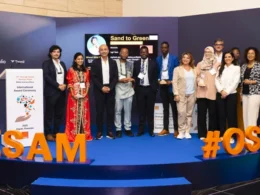
This year’s event brought together nearly 500 startup representatives and close to 200 investors from 50 countries. The conference was officially opened by Daniel Schaer, Estonia’s Ambassador-at-Large for African Affairs, Henriette Geigeris, the European Union Ambassador to Kenya, and Hon. William Kabogo Gitau, Cabinet Secretary of Kenya’s Ministry of Information, Communications and the Digital Economy.
Hon. Gitau described Latitude59 as “a bridge between ecosystems, capital, and ideas,” underscoring Kenya’s commitment to deepening tech ties with Europe.
The conference focuses on accelerating Africa’s next wave of innovation through Digital and Green Innovation—themes that align with the European Union’s D4D Hub Twin Transition Team Europe Initiative. Latitude59 Kenya 2025 is delivered in cooperation with ESTDEV, Estonia’s development agency, marking a shift from pure commercial conference to strategic development partnership.
“Estonia is in Kenya and is here to stay. We are coming to cooperate, co-create and learn from you,” Ambassador Schaer emphasized, signaling long-term commitment beyond the conference circuit.
The Pitch Competition That Matters
For many attendees, the highlight remains the L59 Pitch Competition. This year’s edition attracted 382 applications from 37 countries, with only ten startups making it to the final stage at Nairobi’s ASK Dome. VunaPay, a fintech solution targeting farmers, emerged victorious, securing the top prize and a trip to Latitude59 2025 in Tallinn.
Past winners have leveraged the platform for significant growth. Chumz.io, which won the 2023 edition, has since expanded operations across Africa and secured additional funding. The competition’s prize pool has grown significantly—the 2025 Tallinn edition featured €675,000 in official prizes, with follow-up investments pushing the total even higher.
Previous Kenya editions saw winners and finalists receive packages including legal counseling from KTA Advocates, spots in Startup Wise Guys’ Africa program, coworking memberships at Nairobi Garage, and service credits worth tens of thousands from partners like Infobip.
Why Estonia Is Betting on Africa
Estonia’s African expansion strategy extends beyond Kenya. The country now hosts satellite Latitude59 events in Singapore and Cape Town, but Kenya remains the anchor of its African engagement. Estonian startups like Bolt, Admiral Markets, and Yaga are already active across Africa, with Bolt operating in over 40 countries spanning Europe, Africa, and South America.
The strategic logic is clear: Estonia’s tiny domestic market forces its startups to think globally from day one. “Estonia is home to the highest concentration of unicorns in Europe, boasting 865 startups per 1M people,” organizers noted. But with a population smaller than many African cities, Estonian founders need external markets to scale.
Kenya offers that scale. The country’s tech sector now accounts for 1.1% of Kenya’s GDP, with innovation hubs like iHub spawning over 152 successful startups. Global tech giants including IBM, Intel, and Microsoft have established a presence in Nairobi, with Microsoft announcing a $1 billion data center investment in nearby Naivasha.
Real Connections, Real Opportunities
Nearly 100 speakers took the stage over two days, including Taavi Kotka, one of the architects behind Estonia’s digital transformation, and Dr. Myriam Sidibé, a global leader in public health and social impact. But the real value, participants said, came from the connections forged in hallways, at demo booths, and during evening networking sessions.
“Youth is the driving force of Kenya’s economy, and Latitude59 helps transform their innovative ideas into fully functioning enterprises,” said Emmanuel Kata Kimeu, Secretary for ICT Security and Audit Control at Kenya’s State Department of ICT and Digital Economy.
For Dolores Daniel, project manager for Latitude59 Kenya, the exchange runs both ways. “It’s incredible to see how motivated and eager these young entrepreneurs are, and I am very happy that we can share our knowledge and experiences with them. At the same time, we have a lot to learn from Kenyan entrepreneurs—how to find simple solutions to complex problems, to be open minded, and to be bold.”
The Bigger Picture
Latitude59’s African expansion reflects broader geopolitical and economic shifts. As China deepens its infrastructure investments across Africa and the United States focuses on strategic tech partnerships, the EU is positioning itself as a values-aligned partner offering digital expertise, regulatory frameworks, and capital.
Estonia serves as the perfect messenger. Its e-residency program has attracted over 100,000 digital citizens from 170+ countries. Its digital government infrastructure has been adopted everywhere from Ukraine to Kenya. And its startup ecosystem continues to punch wildly above its weight class.
For Kenya, the partnership offers validation of its “Silicon Savannah” ambitions. The country faces real challenges—regulatory complexity, infrastructure gaps, and competition from Lagos and Cape Town—but events like Latitude59 signal that international investors and ecosystem builders see Kenya as a critical node in the global tech network.
The question isn’t whether Estonia and Kenya will continue collaborating—Org has already confirmed plans to return. The question is whether this model of tech diplomacy, built on genuine ecosystem connections rather than top-down government programs, can deliver the kind of transformative outcomes both sides are betting on.
Based on the energy in Nairobi this week, the early signs are promising.