



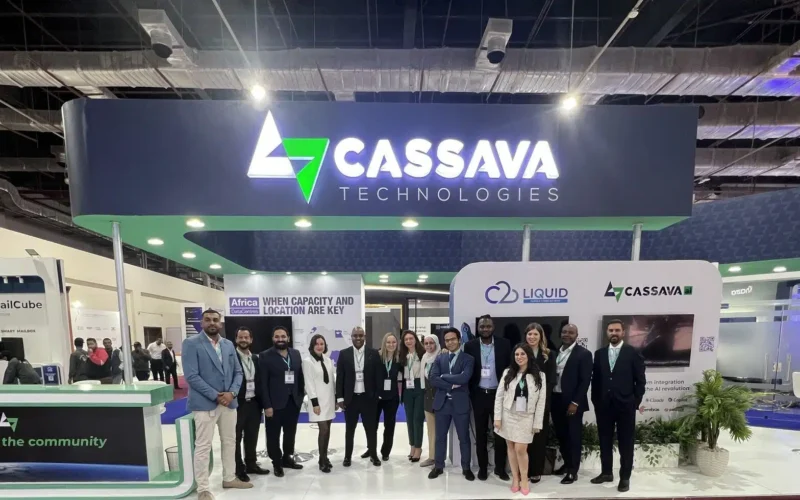
Cassava Technologies, the pan-African digital infrastructure giant founded by Zimbabwean billionaire Strive Masiyiwa, announced today a strategic partnership with AXON Networks to deploy Africa’s first end-to-end Operator-as-a-Service (OaaS) platform. The collaboration transforms Cassava’s massive 110,000-kilometer fiber backbone—stretching from Cape Town to Cairo, connecting 20+ African countries—into an AI-managed, self-learning, autonomous network infrastructure that provisions services in near real-time instead of weeks.
The partnership, unveiled at Counder Conference 2026 in Cape Town before 500 global investors and family office principals, represents a fundamental shift in how African telecommunications infrastructure operates. Instead of manual network design and configuration, AXON’s digital twin technology creates a living, virtualized replica of Cassava’s entire network—terrestrial fiber, submarine cables, satellite capacity, wireless connectivity—that continuously learns, optimizes, and self-heals.
For African businesses, mobile operators, LEO satellite providers, and ISPs, the implications are transformative: network provisioning drops from weeks to minutes, operational costs plummet through AI automation, and access to enterprise-grade infrastructure becomes available to startups and SMEs who couldn’t afford traditional telecom services.
But the strategic ambition extends far beyond operational efficiency. Cassava and AXON are building the foundational platform for Africa’s AI economy—the connectivity layer that enables the continent’s planned “AI sovereignty” through locally-controlled, AI-powered infrastructure that doesn’t depend on foreign cloud giants.
This isn’t an incremental improvement. It’s an infrastructural transformation.
The Platform: Digital Twins Meet 110,000km of African Fiber
At its core, the Cassava-AXON partnership virtualizes physical network infrastructure into software-defined, AI-managed systems.
What Is Operator-as-a-Service?
Traditional telecommunications require dedicated hardware, manual configuration, and lengthy deployment cycles. An enterprise needing private network connectivity across Lagos, Nairobi, and Johannesburg might wait 3-6 months for provisioning, procurement, installation, configuration, and testing.
Operator-as-a-Service flips this model. Instead of physical provisioning, customers access virtualized network services through software interfaces. AXON’s platform creates a digital twin—a precise, real-time software model of Cassava’s entire network—enabling:
- Near-instant provisioning: Customer networks deployed in minutes, not weeks
- Dynamic reconfiguration: Bandwidth, routing, and capacity are adjusted in real-time based on demand
- AI-driven optimization: Machine learning algorithms continuously improve network performance
- Self-healing infrastructure: Automated fault detection and rerouting prevent outages
- Multi-tenancy: Multiple customers securely share physical infrastructure through virtualization
Hardy Pemhiwa, President & Group CEO of Cassava Technologies, framed the strategic imperative clearly: “As businesses of all sizes continue to digitise their operations, the need is for cost-effective, flexible, high-performance network solutions that reduce time-consuming manual design and configurations. By partnering with AXON Networks, we are moving beyond traditional hardware-centric infrastructure to create a truly programmable, AI-managed network.”
The transformation allows Cassava to “treat our pan-continental fibre network as a dynamic digital platform, enabling us to provision and modify customer networks in near real-time, rather than days or weeks.”
The Scale: 110,000km of Fiber Becomes Software
Cassava’s infrastructure footprint provides the physical foundation:
- 110,000+ kilometers of terrestrial and submarine fiber across 20+ African countries
- Cape Town to Cairo fiber route: Africa’s first terrestrial network connecting southern and northern extremes
- Satellite capacity: Filling gaps in terrestrial coverage across remote regions
- Wireless connectivity: Last-mile access where fiber doesn’t reach
- AI-enabled data centers: Africa Data Centres network providing compute infrastructure
Liquid Intelligent Technologies, Cassava’s connectivity business unit, operates Africa’s largest cross-border fiber network, serving 50+ global wholesale carriers and thousands of enterprise customers across Eastern, Central, and Southern Africa.
AXON’s digital twin technology virtualizes this entire physical infrastructure into software that can be programmed, analyzed, and optimized like a cloud platform. Martin Manniche, CEO and founder of AXON Networks, explained the vision: “We’re not just mirroring networks—we’re virtualising an entire infrastructure into a live AI-driven ecosystem that will leverage this extensive backbone, including Cassava’s planned AI-powered factory, to bring growth, prosperity, and the promise of AI sovereignty to Africa and its people.”
The Business Model: Infrastructure-as-Code for African Telecoms
The OaaS platform creates new revenue streams and business models that didn’t exist under traditional telecom architectures.
Target Customers: Beyond Traditional Enterprises
Mobile Network Operators (MNOs):
Rather than building their own fiber infrastructure—capital-intensive and time-consuming—MNOs can lease virtualized capacity from Cassava’s OaaS platform, rapidly deploying services in new markets without physical buildouts.
LEO Satellite Providers:
Companies like Starlink, OneWeb, and Amazon’s Project Kuiper need ground infrastructure to connect satellite capacity to end-users. Cassava’s platform provides instant integration points across Africa, enabling satellite operators to reach customers without building terrestrial networks.
Internet Service Providers (ISPs):
Small and medium ISPs can access enterprise-grade backbone infrastructure without capital expenditure, competing with established players through software-defined services.
Enterprises and Startups:
Companies needing private networks for IoT deployments, industrial operations, or multi-country connectivity can provision services directly, bypassing traditional telecom sales cycles and long-term contracts.
Government and Public Sector:
Digital government initiatives, e-health networks, and education connectivity programs can leverage OaaS for rapid, cost-effective deployment at scale.
The Economics: From CAPEX to OPEX
Traditional telecom infrastructure requires massive upfront capital investment—fiber installation, equipment procurement, data center construction—followed by ongoing operational expenses.
OaaS shifts this model from capital expenditure (CAPEX) to operational expenditure (OPEX):
- Customers pay for capacity consumed, not infrastructure built
- Provisioning happens through software, not physical deployment
- Scaling up or down occurs instantly without hardware changes
- Multi-tenancy means infrastructure costs are shared across customers
For Cassava, the model increases asset utilization. Physical fiber that once served one customer can now simultaneously serve dozens through virtualization—dramatically improving return on infrastructure investment.
For customers, the model reduces barriers to entry. A Nigerian fintech doesn’t need $5 million to build private network infrastructure—they can provision virtualized services for $50,000 monthly, scaling as they grow.
The Strategic Context: Why This Matters for African Tech
The Cassava-AXON partnership arrives at an inflection point for African digital infrastructure.
1. The AI Infrastructure Gap
Africa’s participation in the global AI economy depends on infrastructure that most of the continent lacks:
- High-speed connectivity: Training and deploying AI models require massive bandwidth
- Low-latency networks: Real-time AI applications (autonomous systems, robotics, live translation) demand sub-100ms latency
- Compute capacity: AI workloads need GPUs and specialized processors, typically in data centers
- Data sovereignty: Training AI on African data requires African infrastructure, not foreign clouds
Cassava is addressing all four simultaneously. The company received $90 million in equity investment from the U.S. International Development Finance Corporation (DFC), Google, and Finland’s Finnfund, specifically to expand digital infrastructure supporting AI adoption. Partnerships with Microsoft, AWS, Anthropic, and Nvidia provide access to cutting-edge AI technologies.
The AXON partnership makes this infrastructure programmable and accessible—no longer requiring multi-million-dollar contracts and year-long deployments.
2. The Connectivity Deficit
Sub-Saharan Africa remains the world’s least connected region despite being one of the fastest-growing internet markets. Over 600 million Africans lack electricity access, and hundreds of millions more lack reliable internet.
Cassava’s 110,000km fiber network addresses this through:
- Cross-border connectivity: Linking countries that previously depended on expensive satellite backhaul
- Redundancy and resilience: Multiple route options prevent single points of failure
- Capacity at scale: Bandwidth sufficient for millions of simultaneous users
But infrastructure alone isn’t enough. The AXON partnership makes this capacity accessible and affordable through virtualization—allowing smaller players to leverage infrastructure that only giants could previously afford.
3. The AI Sovereignty Imperative
African nations increasingly recognize that dependency on foreign cloud providers creates strategic vulnerabilities:
- Data privacy risks: Sensitive government, health, and financial data stored on foreign servers
- Regulatory complexity: Compliance with GDPR, CFPB, and other foreign regulations
- Economic leakage: Payments for cloud services flow offshore rather than building local capacity
- Censorship and control: Foreign providers can restrict access based on geopolitical considerations
Cassava’s model—African infrastructure, African ownership, African data storage—provides an alternative. The “AI sovereignty” Manniche references means African AI models trained on African data, running on African infrastructure, controlled by African institutions.
This matters for healthcare (medical AI trained on African patient populations), agriculture (crop models optimized for African climate and soil conditions), financial services (credit scoring using African transaction patterns), and governance (AI tools designed for African administrative contexts).
The Technology: How Digital Twins Enable Autonomous Networks
AXON’s breakthrough is applying digital twin technology—originally developed for manufacturing and industrial systems—to telecommunications networks at a continental scale.
What Is a Digital Twin?
A digital twin is a virtual replica of a physical system that mirrors real-world conditions in real-time. Changes in the physical system instantly reflect in the digital model, enabling simulation, prediction, and optimization.
In manufacturing, digital twins model production lines—identifying bottlenecks, predicting equipment failures, optimizing workflows. In telecom, AXON’s digital twin models Cassava’s entire 110,000km network:
- Real-time monitoring: Traffic flows, bandwidth utilization, latency patterns, fault conditions
- Predictive analytics: Machine learning identifies potential failures before they occur
- Simulation: Test network changes virtually before implementing them physically
- Optimization: AI algorithms continuously adjust routing, capacity allocation, and resource distribution
The AI Layer: Self-Learning, Self-Optimizing, Self-Healing
Traditional networks require human operators to:
- Monitor traffic patterns manually
- Identify performance degradation
- Diagnose root causes
- Implement fixes through configuration changes
This process takes hours or days. AXON’s AI layer handles it in milliseconds:
Self-Learning:
The system continuously ingests network performance data, learning normal patterns and identifying anomalies. Over time, the AI develops sophisticated models of how the network behaves under different conditions.
Self-Optimizing:
Based on learned patterns, the AI automatically adjusts routing, bandwidth allocation, and traffic prioritization to maximize performance. A sudden traffic surge in Lagos triggers automatic capacity reallocation from underutilized routes.
Self-Healing:
When faults occur—fiber cuts, equipment failures, natural disasters—the AI instantly detects the issue, identifies alternative routing, and reconfigures the network to maintain service continuity. What once required hours of human intervention now happens automatically in seconds.
The Multi-Tenancy Innovation
Critical to the OaaS model is secure multi-tenancy—multiple customers sharing physical infrastructure without compromising security or performance.
AXON’s platform creates virtual “slices” of the network, each isolated from others:
- Performance isolation: One customer’s traffic surge doesn’t impact others
- Security isolation: Data from different customers never intermingles
- Configuration isolation: Each customer manages their virtual network independently
This enables the economic model shift. Instead of dedicated infrastructure per customer (capital-intensive, inefficient), Cassava can serve dozens of customers simultaneously on the same physical fiber (capital-efficient, highly profitable).
The Competitive Landscape: How This Changes African Telecom
The OaaS model threatens to upend traditional telecom economics across Africa.
Incumbent Operators Face Disruption
Traditional African telcos—MTN, Vodacom, Orange, Airtel—built business models on controlling infrastructure and charging premium prices for access. Capital requirements created barriers to entry that protected incumbents.
Cassava-AXON’s OaaS model lowers these barriers dramatically:
- Startups can launch telecom services without building networks
- MVNOs (Mobile Virtual Network Operators) access infrastructure at a scale previously impossible
- ISPs compete nationally without physical presence in every city
- Enterprises bypass telcos for private connectivity needs
Incumbents must respond. Options include:
- Partner with Cassava: Lease OaaS capacity rather than competing
- Build competing platforms: Replicate the model (capital-intensive, time-consuming)
- Focus on retail differentiation: Compete on customer service, pricing, bundling rather than infrastructure
The challenge: incumbents’ cost structures are built on legacy infrastructure and manual operations. Cassava’s AI-driven, virtualized model operates at fundamentally lower cost.
New Market Entrants Accelerate
The OaaS model enables business models that couldn’t exist under traditional telecom economics:
IoT Platforms:
Companies deploying sensors, cameras, and connected devices across Africa can provision connectivity instantly rather than negotiating with multiple national telcos.
Edge Computing Providers:
Distributed compute infrastructure requires low-latency connectivity—exactly what OaaS provides through programmable network slicing.
Fintech Infrastructure:
Digital banks, mobile money platforms, and payment processors need reliable, secure connectivity across multiple countries. OaaS offers instant provisioning and AI-optimized routing.
Content Delivery Networks (CDNs):
Streaming video, gaming, and other bandwidth-intensive services require strategic network placement. OaaS enables dynamic CDN deployment.
Pan-African Expansion Accelerates
Currently, expanding telecom services across African countries requires navigating 54 different regulatory regimes, building or leasing infrastructure in each market, and managing complex interconnection agreements.
Cassava’s pan-African network—already operational in 20+ countries—provides instant market access through a single platform. A startup launching in Nigeria can add Kenya, South Africa, and Ghana within days rather than years.
This geographic arbitrage advantage is massive. Only a handful of companies (Liquid, MTN, Vodacom) operate at this pan-African scale. OaaS democratizes access.
The Execution Challenges: Why This Is Harder Than It Sounds
For all its promise, the Cassava-AXON partnership faces significant technical, operational, and regulatory hurdles.
1. Integration Complexity
Virtualizing 110,000km of heterogeneous network infrastructure—built over two decades, spanning multiple technology generations, operating under different regulatory frameworks—isn’t trivial.
Challenges include:
- Legacy systems: Older fiber segments lack the monitoring capabilities required for digital twin accuracy
- Standards fragmentation: Different network segments use incompatible protocols and management systems
- Data quality: Digital twins are only as accurate as the data feeding them; poor data quality produces unreliable models
- Real-time requirements: AI optimization requires millisecond-level data processing across continental distances
AXON’s digital twin technology has been deployed in European and North American networks, but African infrastructure presents unique challenges—power instability, physical security concerns in conflict zones, limited skilled workforce for maintenance.
2. Operational Transformation
Cassava must transition from traditional telecom operations (manual provisioning, human-driven network management) to software-defined, AI-automated operations.
This requires:
- Staff retraining: Network engineers must learn software-defined networking, AI systems, and cloud platforms
- Process redesign: Procurement, provisioning, support, and billing processes built for manual operations don’t work for instant software provisioning
- Cultural change: Shifting from risk-averse “if it’s not broken, don’t touch it” telecom culture to “continuously optimize and iterate” software culture
Traditional telcos attempting similar transformations (AT&T, Verizon) have struggled for years. Success isn’t guaranteed.
3. Security and Trust
Multi-tenant, virtualized infrastructure creates new attack surfaces:
- Tenant isolation failures: Bugs or misconfigurations could expose one customer’s data to others
- AI vulnerabilities: Machine learning models can be poisoned by adversarial inputs, causing incorrect optimization decisions
- Centralized risk: A breach of AXON’s digital twin platform could compromise Cassava’s entire network
African enterprises—particularly banks, governments, and healthcare providers—have valid concerns about trusting mission-critical connectivity to virtualized, AI-managed platforms. Cassava and AXON must prove security through third-party audits, certifications, and transparent incident response.
4. Regulatory Navigation
Africa’s 54 countries maintain independent telecom regulators, each with unique requirements for licensing, data sovereignty, and infrastructure ownership.
Questions the partnership must resolve:
- Cross-border data flows: Can OaaS customers send traffic between countries without violating data localization laws?
- Licensing requirements: Do virtual network operators need separate licenses in each country where they operate?
- Infrastructure ownership: Some countries restrict foreign ownership of telecom infrastructure—does Cassava’s UK headquarters trigger concerns?
- Taxation: How are services provisioned in one country but consumed in another taxed?
Cassava’s existing regulatory relationships—operating in 20+ countries for years—provide advantages. But OaaS introduces novel questions that regulators haven’t addressed.
The Broader Implications: Infrastructure as Competitive Advantage
The Cassava-AXON partnership should be understood within the context of Strive Masiyiwa’s two-decade strategy to build Africa’s digital backbone.
The Masiyiwa Vision: African Infrastructure, African Ownership
Masiyiwa founded Econet Wireless in 1993, breaking Zimbabwe’s state telecom monopoly through a five-year legal battle that reached the Supreme Court. The experience instilled conviction that African digital infrastructure shouldn’t depend on foreign control or goodwill.
Through Cassava Technologies, founded in 2021 as a holding company for his various digital assets, Masiyiwa has methodically assembled Africa’s most comprehensive tech ecosystem:
- Liquid Intelligent Technologies: 110,000km fiber network, connecting 20+ countries
- Africa Data Centres: Continent’s largest network of carrier-neutral data centers
- Cassava AI: AI solutions provider partnering with Nvidia, Anthropic, Microsoft
- Liquid C2: Cloud security and managed security services
- Sasai Fintech: Digital payments, wallets, and financial services
The strategy is vertically integrated—from fiber to data centers to AI compute to fintech applications—enabling end-to-end control and optimization. The AXON partnership adds the software layer that makes this physical infrastructure programmable.
The AI Sovereignty Thesis
Manniche’s reference to “AI sovereignty” reflects growing African concern about digital dependency.
Currently, African AI adoption largely means:
- Training models on Google Cloud, AWS, or Azure
- Using OpenAI, Anthropic, or Cohere APIs
- Storing data in U.S. or European data centers
- Complying with foreign regulations (GDPR, CFPB)
This creates vulnerabilities. Foreign cloud providers can:
- Raise prices arbitrarily (no alternatives exist)
- Restrict access based on geopolitical tensions
- Mine the African data for their own model training
- Impose foreign legal standards on African data
Cassava’s model—African fiber, African data centers, African AI compute, African-trained models—offers an alternative. The OaaS platform makes this infrastructure accessible to African businesses at scale.
Success would position Africa differently in the global AI economy—not just as consumers of foreign AI, but as producers of AI systems optimized for African contexts, owned by African institutions, generating returns for African stakeholders.
The Timeline: What Happens Next
The partnership announcement marks the beginning, not the end, of deployment.
Phase 1: Platform Integration (Q1-Q2 2026)
AXON’s digital twin software integrates with Cassava’s network management systems. Initial focus on highest-priority routes and largest customers—Lagos-Nairobi-Johannesburg corridor, major data center interconnections, key government and enterprise accounts.
Phase 2: Limited Availability Launch (Q3 2026)
OaaS platform launches for select customers—existing Cassava enterprise clients, strategic partners, pilot programs with mobile operators and ISPs. This phase validates technical integration, refines pricing models, and identifies operational issues before full launch.
Phase 3: General Availability (Q4 2026-Q1 2027)
OaaS platform opens to all customers across Cassava’s 20+ country footprint. Marketing push targets startups, ISPs, MVNOs, and enterprises. Partner ecosystem develops—system integrators, managed service providers, application developers building on the platform.
Phase 4: Feature Expansion (2027+)
Advanced capabilities roll out: edge compute integration, 5G network slicing, satellite-terrestrial convergence, AI-powered network optimization for specific use cases (IoT, real-time video, industrial automation).
The Bottom Line
Cassava Technologies and AXON Networks are attempting something unprecedented: transforming 110,000 kilometers of physical fiber infrastructure into a software-defined, AI-managed platform that provisions network services in minutes instead of months.
If successful, the implications extend far beyond operational efficiency. The partnership creates the connectivity layer for Africa’s AI economy—the infrastructure enabling local model training, low-latency applications, and digital sovereignty that doesn’t depend on foreign cloud giants.
For African startups, the OaaS model democratizes access to infrastructure that previously required multi-million-dollar contracts and physical presence in dozens of countries. A Nigerian fintech can provision connectivity across Kenya, Ghana, and South Africa in days. A Kenyan IoT company can deploy sensors across 15 countries through software provisioning.
For Cassava, the partnership represents the culmination of Strive Masiyiwa’s two-decade strategy to build African-owned, African-controlled digital infrastructure. The AXON collaboration adds the intelligence layer—AI and automation—that makes massive physical infrastructure accessible at scale.
The execution challenges are real. Integrating heterogeneous networks, transforming telecom operations, navigating 54 regulatory regimes, and proving security to skeptical enterprises—none of this is trivial.
But the strategic vision is compelling: Africa’s digital backbone, made programmable through AI, enabling the continent to participate in the global digital economy on its own terms.
The announcement at Counder Conference 2026, before 500 global investors, signals confidence—not just from Cassava and AXON, but from the capital markets watching closely. If the model works, expect similar partnerships to follow as incumbents scramble to replicate the OaaS approach.
For African tech, January 28, 2026, may mark the day infrastructure became software, and connectivity became code.






Comments 1