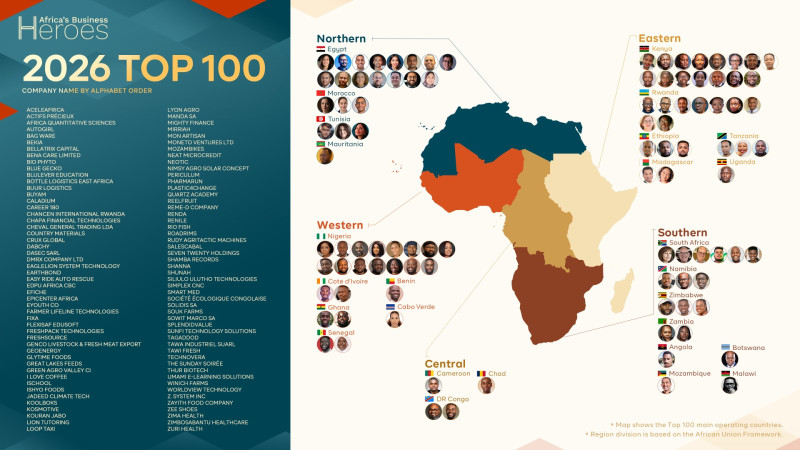
Africa’s Business Heroes has unveiled its largest-ever cohort of entrepreneurs, selecting 100 finalists from more than 24,000 applications received across all 54 African countries — a milestone that marks both a structural expansion of the competition and a significant test of its ability to convert visibility into lasting economic outcomes.
The 2026 edition, announced on June 11 from Kigali, Rwanda, is the eighth cycle of the Jack Ma Foundation and Alibaba Philanthropy’s flagship pan-African entrepreneurship programme. For the first time in its history, the initiative doubled its opening round from a Top 50 to a Top 100, a decision the organisers say reflects the growing commercial depth and competitiveness of African entrepreneurship as the competition approaches its ten-year anniversary.
A Cohort That Earns Its Numbers
The aggregate data behind this year’s Top 100 is unusually concrete. Collectively, the selected businesses generated $170 million in revenue during 2025, employed 6,200 people, and served a combined 10 million customers, according to ABH. The average founder in the cohort is 38 years old, running a business with an average operating history of 6.5 years. These are not idea-stage startups. Half of the Top 100 are returning applicants, a signal that the programme has built genuine community loyalty and that entrepreneurs see repeated participation as a viable path to selection.
The cohort represents 27 countries, with strong sectoral representation across AI, agriculture, fintech, health, and climate. Women accounted for the highest share of total applications since the competition launched in 2019 — a meaningful improvement, though ABH did not release a precise percentage. Notably, emerging startup hubs including Angola, Burkina Faso, Chad, Libya, Madagascar, and Mozambique all recorded increased participation, suggesting the programme’s community-building tour across ten African markets this year is producing results beyond optics.
The Road to Nairobi and $1.5 Million
The Top 100 will now enter a video interview round with seasoned business leaders. From that assessment, the field narrows to a Top 20, who will pitch live on August 21 and 22 in Nairobi, Kenya. The final ten will compete for a share of the $1.5 million grant prize, with the top winner eligible for up to $300,000. No repayment, no dilution.
The prize architecture has not changed materially since the competition’s second year, but the path to it has become more structured. Beyond the grant, finalists gain access to mentorship networks, media exposure, and connections to institutional investors — advantages that past participants credit with accelerating follow-on fundraising. In a year where African startup funding is concentrating heavily at the top end of the market, non-dilutive capital of this scale carries outsized weight for founders outside the Lagos-Nairobi-Cairo corridor.
What Expanding to 100 Finalists Actually Tests
The shift from 50 to 100 is the most consequential structural change in ABH’s history. The stated rationale is inclusion — more visibility for more founders, especially from underrepresented geographies. That argument is defensible. Countries that have historically produced few ABH finalists now have a larger pool of nominated representatives, and the expanded bootcamp stage creates more touchpoints for founders with ecosystem leaders and potential investors.
The risk, however, is dilution of signal. One of the programme’s most valuable assets is the implied endorsement of a Top 10 or Top 50 selection. Doubling the cohort while keeping the prize pool constant may weaken that signal unless ABH invests proportionately in the quality of engagement each of the 100 founders receives. Last year’s ABH Top 50 cycle drew more than 32,000 applications — meaning the 2026 field of 24,000 is actually smaller, even as it produced a larger finalist pool. ABH has not explained that discrepancy, and it is worth watching whether application volumes stabilise, rebound, or continue declining as the programme matures.
A Landmark Year With Open Questions
ABH approaches its ten-year milestone having disbursed grant funding to eighty entrepreneurs across eight cycles, built a pan-African alumni community, and embedded itself into the continent’s most active startup hubs. The 2026 competition’s expanded reach into Namibia, Tunisia, and Zambia — countries the programme is explicitly prioritising because they have been underrepresented in past Top 10 cohorts — is a genuine effort to close geographic gaps that have persisted since the programme’s launch.
The question that matters more than the finalist count is what the Top 10, when announced, will look like in five years. ABH’s founders are, by design, already generating revenue, employing people, and serving customers at scale. The programme has the data to track that impact over time. Whether it publishes it consistently — and whether Africa’s broader entrepreneurship ecosystem can absorb the talent these competitions surface — remains the more important accountability question.