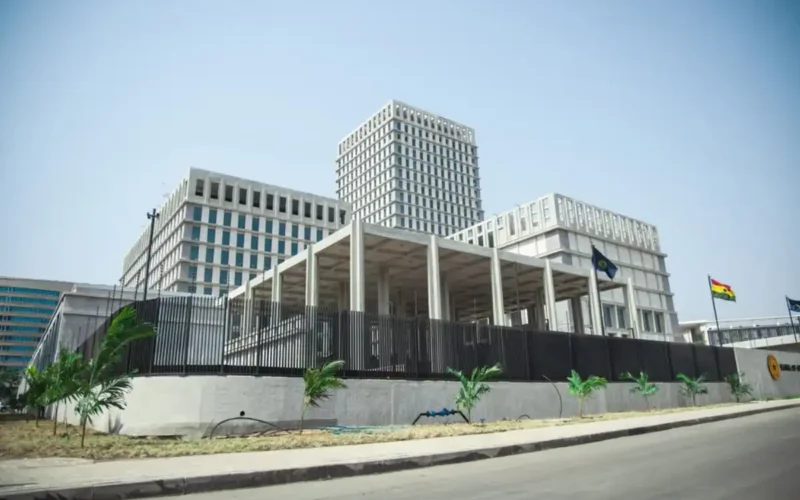
Ghana’s central bank ordered every licensed bank, payment company, and electronic money issuer in the country to immediately sever ties with cryptocurrency platforms offering unauthorised dollar-denominated wallet services — drawing the sharpest regulatory line yet between the formal financial system and uncleared digital finance activity in West Africa.
The Bank of Ghana issued the directive on June 12, 2026, under Notice No. BG/GOV/SEC/2026/14, signed by Bank Secretary Aimee Vyda Quashie. It was publicly released days later, triggering immediate concern across Ghana’s crypto user base and the fintech operators who serve them.
Who Gets Cut Off and Why
The sweep is comprehensive. Banks, Specialised Deposit-Taking Institutions, Electronic Money Issuers, Payment Service Providers, and all other regulated financial institutions are prohibited from establishing or maintaining any arrangement that facilitates the funding, operation, settlement, or customer access to unauthorised foreign currency wallet services offered by crypto platforms to users in Ghana. The directive covers bank transfers, payment cards, card acquiring infrastructure, and settlement rails — every channel through which a Ghanaian bank or payment operator could provide upstream support to a crypto wallet service.
The BoG’s stated concern is specific: cryptocurrency platforms have been offering US dollar-denominated wallets that allow Ghanaians to hold and transact in foreign currency through channels that bypass the formal banking system’s oversight mechanisms. According to the central bank, these activities require authorisation under the Payment Systems and Services Act, 2019 (Act 987) and the Foreign Exchange Act, 2006 (Act 723). The BoG stated plainly that “the relevant crypto platforms have not been authorised by the Bank of Ghana to undertake such activities.”
No specific platform was named. The directive applies to all configurations where a regulated institution provides any financial infrastructure in support of such arrangements — and instructs those currently in such arrangements to dismantle them immediately, not merely to stop accepting new transactions.
The Regulatory Contradiction at the Heart of the Directive
This directive arrives less than six months after Ghana’s Parliament passed the Virtual Asset Service Providers Act on December 22, 2025 — establishing the country’s first comprehensive legal framework for regulating crypto businesses. At the time, the BoG and the Securities and Exchange Commission committed to issuing licensing and registration guidelines within the first quarter of 2026. More than 100 crypto firms registered operations in Ghana after the legislation came into force, operating in anticipation of those guidelines.
Those licensing rules have not yet been finalised. The June 12 directive lands, therefore, in a window where Parliament has legalised the sector but the regulator has not yet issued the operational licences that would make crypto platforms compliant. The entities now ordered cut off are, technically, operating in a legislated but unlicensed sector — a position created as much by regulatory delay as by industry non-compliance. Ghana’s previous digital lending crackdown in late 2025 produced a similar dynamic, where broad enforcement action landed before graduated compliance pathways were in place.
The consequences for consumers are immediate. Ghanaians who hold dollar-denominated balances on crypto platforms funded through local bank transfers or mobile money face disruption to those funding and withdrawal channels as regulated institutions race to comply. The BoG has warned that non-compliance may result in “supervisory or enforcement actions,” without specifying the sanctions, which gives banks strong incentive to move quickly. For crypto users, that urgency translates directly into access disruption.
Forex Control and a $3 Billion Market
The directive’s economic logic is straightforward: dollar-denominated crypto wallets allow Ghanaians to hold foreign currency outside the formal banking system, weakening the central bank’s ability to monitor and manage Ghana’s foreign exchange position. Ghana’s exchange rate and forex reserves have been subject to intense pressure in recent years, and the BoG has reason to be protective of visibility into cross-border currency flows.
The scale of the activity being targeted is not trivial. Ghana recorded crypto transactions exceeding $3 billion between July 2023 and June 2024, driven by a tech-savvy population using digital assets both as a store of value against cedi depreciation and as a dollar access mechanism. A meaningful share of that volume moved through exactly the kind of local bank and mobile money rails this directive now seeks to cut.
This is the broader regulatory pattern taking shape across West Africa. Nigeria’s central bank and SEC have been building a parallel crypto oversight framework, driven by similar concerns about naira stability and unauthorised dollar flows. The instinct is consistent: regulate the on-ramp, not the asset. Cut off local banking infrastructure and you restrict access to crypto without banning ownership outright.
The critical question is whether this enforcement-first approach can hold while licensing is still pending. Ghana has created a legal sector without a functioning licence regime. The BoG’s directive effectively freezes that sector in place until authorised operators can be distinguished from unauthorised ones — a distinction the regulator has not yet provided the tools to make. Until the Virtual Asset Service Providers licensing guidelines materialise, Ghana’s crypto industry operates in a state of regulatory ambiguity that has become familiar across the continent’s fintech sector.