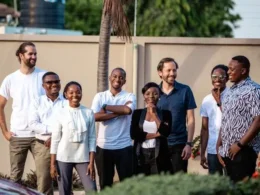
Interswitch has appointed Abdul-Hafiz Ibrahim as its new Chief Technology Officer, promoting a near decade-long company veteran into one of the most consequential engineering roles in African fintech. Ibrahim announced the move on LinkedIn, describing it as the product of years spent growing inside the company rather than a lateral hire brought in from outside.
“Having spent much of my career growing within Interswitch, it’s a privilege to take on this responsibility at a time when technology is reshaping our industry faster than ever before,” Ibrahim wrote, framing artificial intelligence and new engineering practices as forces “redefining how products are built, how businesses operate, and how value is created.”
Why Interswitch Is Betting on an Internal Promotion
Ibrahim’s rise through Interswitch’s engineering ranks has been gradual rather than dramatic. He joined as a Platforms Software Engineer and moved through Software Architect and Principal Software Architect roles before taking charge as Divisional Head of Engineering across Digital Commerce, Merchant Acquiring, and Commercial Inclusion. That trajectory matters at a company whose institutional memory runs deep. Founded in 2002, Interswitch remains one of the earliest and most consequential players in Nigeria’s tech ecosystem, and its Verve card scheme still anchors much of the country’s domestic card infrastructure.
The timing is not incidental. Interswitch posted ₦137.5 billion in revenue for the year ended March 2025, a 50 percent jump that reversed a ₦1.7 billion pretax loss the previous year — a loss driven partly by naira volatility and a ₦30 billion chargeback fraud incident that rattled the company. A new CTO inherits both the turnaround and the pressure to keep it going, at a company whose backers include Visa, LeapFrog Investments, and Helios Investment Partners.
The Competitive Pressure Behind the New CTO’s Mandate
Ibrahim steps into the role as Interswitch fights a two-front war it did not have to fight a decade ago. On one side sit mobile money-native challengers like Moniepoint and OPay, which have built agent networks and wallet products that appeal to underbanked users faster than Interswitch’s card-based legacy rails can match. Moniepoint alone closed a $200 million Series C round backed by LeapFrog Investments, a firm with a long track record funding African fintech infrastructure, and it now issues Verve cards under license from Interswitch itself — a partnership that could just as easily tip into rivalry.
On the other side, Visa’s minority stakes in Interswitch, Flutterwave, and Moniepoint have created what analysts call a “Visa Triangle,” an arrangement that ties Interswitch’s switching infrastructure to global card rails even as domestic players push to reduce that dependence. Interswitch has responded by securing a mobile money operator license for its M-Kudi subsidiary and restructuring into a Payment Service Holding Company under Central Bank of Nigeria rules, separating core infrastructure from commercial units.
None of that restructuring solves the harder problem: building an engineering organisation fast enough to out-innovate rivals that were born mobile-first while Interswitch was still card-first. Ibrahim’s own language leans heavily on AI and “world-class execution,” but Interswitch’s growth is still 90 percent dependent on Nigeria, exposing the entire technology stack to the same naira volatility and policy shifts that produced the 2023 loss. The company’s pan-African footprint spans mobile money licensing across markets like Uganda, but scaling engineering talent and infrastructure across those markets carries its own execution risk, particularly as Lagos data centre capacity struggles to keep pace with the demands of the country’s fintech unicorns.
Ibrahim used his announcement to thank “colleagues, mentors, and everyone who has been part of this journey,” signalling continuity over disruption. Whether that continuity translates into the kind of engineering speed Interswitch needs against faster-moving rivals is the question the market will be watching over the next year.