



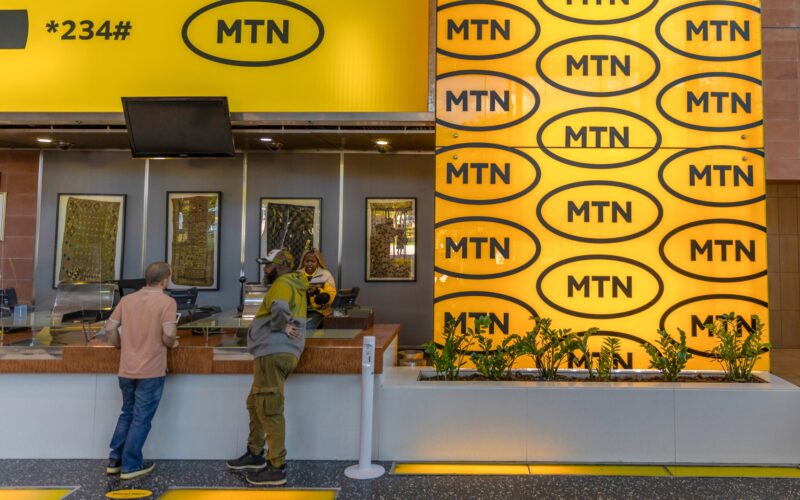
MTN Ghana has officially emerged as the third-largest subsidiary within MTN Group, marking a significant milestone in the telecom giant’s continental performance rankings. The elevation, announced by MTN Group CEO Ralph Mupita during a three-day working visit to Ghana last week, places the West African nation alongside MTN South Africa and MTN Nigeria as the company’s three “major subsidiaries” across its 18 operational markets serving over 300 million subscribers.
“Up until the end of last year, we had two major subsidiaries within the context of the MTN Group across all markets serving the 300 million plus customers, South Africa and Nigeria,” Mupita told media in Accra on Friday, February 20. “This year, we are adding Ghana as the third major subsidiary for the whole group, purely as a function of the way it has performed and the potential that we see going forward.”
The elevation isn’t ceremonial. It comes with a $1.1 billion capital expenditure commitment over the next three years — more than the $1 billion MTN Ghana invested over the previous five years. It comes with plans to deploy 500 new cell sites in 2026 alone, a tenfold increase from the 50 sites built in 2025. And it comes with a mandate to lead MTN Group’s experiments in AI-powered fraud detection, mobile money expansion, and 5G deployment — bets that will determine whether MTN can maintain its dominance in African telecoms or lose ground to competitors investing even more aggressively.
For Ghana — a country of 34 million people, sandwiched between Nigeria and Côte d’Ivoire, with an economy heavily dependent on cocoa exports and remittances — the designation is validation that its telecommunications market has reached the scale and strategic importance to compete with Africa’s two giants. The question is whether MTN Ghana can deliver on the expectations that come with that status.
What “Major Subsidiary” Actually Means
In corporate speak, designations like “major subsidiary” can be meaningless — PR language designed to make investors feel good. But within MTN Group, which operates across 18 countries from South Africa to Afghanistan, the distinction carries weight.
According to Ebenezer Asante, MTN Group Senior Vice President, the “major subsidiary” classification determines:
- Capital allocation priorities — major subsidiaries get first access to capex budgets
- Regulatory attention — Group CEO engages directly with government and central banks
- Product piloting — new services (AI tools, fintech products, 5G applications) launch in major markets first
- Performance benchmarking — major subsidiaries are measured against each other, not against smaller markets
Until 2025, only MTN South Africa and MTN Nigeria held that status. South Africa is MTN’s home market, accounting for the largest revenue contribution. Nigeria, with over 220 million people and explosive data demand, is the company’s largest subscriber base. Ghana, by comparison, has 34 million people — roughly 15% of Nigeria’s population.
But population size isn’t the only metric that matters. What matters is revenue density, data adoption, mobile money traction, regulatory stability, and growth trajectory. And on those dimensions, Ghana is outperforming several larger markets.
MTN Ghana won MTN Group’s internal “Million Dollar Challenge” in 2025 — a competition across all 18 markets measuring operational excellence, customer service, and strategic execution. That’s not a participation trophy. It’s evidence that MTN Ghana’s management team, led by CEO Stephen Blewett, is executing better than counterparts in Nigeria, Uganda, Côte d’Ivoire, and every other market in the portfolio.
The $1.1 Billion Bet on Infrastructure
MTN Ghana currently operates over 5,000 telecom sites nationwide. In 2024, it added 25-30 new sites. In 2025, it added 50. This year, it plans to deploy at least 500 — a tenfold jump tied directly to quality-of-service targets and coverage expansion into peri-urban and rural areas.
That acceleration is expensive. Building a single telecom site — tower, base station equipment, backhaul connectivity, power systems — costs anywhere from $150,000 to $300,000 depending on location and technology. Deploying 500 sites means $75 million to $150 million in infrastructure capex for 2026 alone, with the balance of the $1.1 billion going toward fiber rollout, data center development, 5G equipment, and digital services platforms over the following two years.
Mupita framed the investment in terms that
resonate with Ghana’s government: digital inclusion, job creation, and economic transformation. “We already have 5,000 sites where we have telecommunications equipment that connect our customers here in Ghana. Just this year alone, we’re going to add another 500,” he said.
The network expansion is explicitly designed to address Ghana’s urban-rural connectivity gap. MTN currently provides strong coverage in Accra, Kumasi, and major urban centers, but rural penetration remains weak. The 500 new sites will prioritize underserved areas where mobile broadband is either unavailable or unreliable — critical infrastructure for farmers, small traders, and rural healthcare workers who increasingly depend on mobile access to markets, payments, and information.
But infrastructure alone doesn’t generate returns. The bet is that better coverage drives data consumption, which drives revenue, which justifies the capex. And that bet only pays off if Ghana’s economy continues growing, data prices stay profitable, and competitors don’t undercut MTN’s pricing to steal market share.
The AI Push: Fraud, Fintech, and the Mobile Money Problem
MTN Ghana’s elevation to major subsidiary status comes with strategic mandates beyond infrastructure. One of the most consequential: deploy AI to combat mobile money fraud.
Ghana’s mobile money ecosystem has exploded over the past five years. MTN Mobile Money (MoMo) is the market leader, processing billions of cedis in transactions monthly. But explosive growth has attracted fraud at scale — SIM swap scams, phishing attacks, fake merchant accounts, and organized crime networks that exploit weak KYC (Know Your Customer) processes to launder money.
During his visit, Mupita met with officials from the Bank of Ghana (BoG), Ghana’s central bank, to discuss regulatory collaboration on fraud prevention. “We are going to bring artificial intelligence (AI) to improve the ability to deal with scams and fraud that we see particularly in the mobile money market,” Mupita said.
The AI tools MTN is deploying will analyze transaction patterns in real-time to detect anomalies — a user who suddenly transfers large sums to multiple new recipients, a merchant account that processes thousands of small transactions in minutes, a SIM card that’s used across multiple devices within hours. These patterns flag fraud attempts before money leaves the system.
But AI-powered fraud detection is expensive to build and maintain. It requires machine learning models trained on millions of transaction records, continuous model updates as fraudsters evolve tactics, and integration with telco systems, banking APIs, and regulatory reporting infrastructure. MTN Group is betting that Ghana’s mobile money ecosystem is large enough, and fraud losses significant enough, to justify that investment.
If the AI fraud tools work in Ghana, MTN will roll them out across other markets. If they don’t — if false positives block legitimate transactions, or if fraudsters find workarounds faster than MTN can update models — the investment becomes a sunk cost.
Mupita identified digital economy and fintech as the two primary engines of growth for MTN Ghana, revealing plans to introduce more advanced financial services while maintaining close engagement with regulators to align with national financial inclusion goals.
The 5G Fight: Spectrum, Politics, and Timing
MTN Ghana wants 5G spectrum. Badly. And it’s using its new “major subsidiary” status to lobby the Ghanaian government for access.
During the visit, Mupita and his delegation met with Ghana’s Minister of Communications, Digital Technology and Innovations, Samuel Nartey George, to discuss spectrum allocation. The message was direct: Ghana needs 5G to remain competitive regionally, and MTN is ready to deploy it immediately if spectrum is released.
The business case for 5G in Ghana isn’t about faster smartphones. It’s about Fixed Wireless Access (FWA) — using 5G infrastructure to deliver home broadband without laying fiber to every house. In markets where fiber-to-the-home infrastructure is sparse and expensive, FWA offers a faster, cheaper alternative. Users install a 5G modem at home, and bandwidth comes over the air rather than through cables.
MTN’s pitch to the government is that 5G-powered FWA can bring affordable broadband to millions of Ghanaians who currently lack reliable internet access — enabling remote work, online education, telemedicine, and digital entrepreneurship. But that pitch only works if MTN gets access to the right spectrum bands — specifically 700 MHz (for coverage) and 3,500 MHz (for capacity).
Ghana’s spectrum allocation process has historically been slow and politicized. Licenses are expensive. Auctions are contentious. And incumbent operators like Vodafone Ghana and AirtelTigo are also lobbying for spectrum. MTN is betting that its “major subsidiary” status — and the $1.1 billion capex commitment — gives it leverage in those negotiations.
If MTN gets 5G spectrum in 2026, it can deploy FWA services by early 2027 and differentiate itself from competitors still stuck on 4G. If it doesn’t, the $1.1 billion infrastructure investment delivers less ROI because data demand growth plateaus without a new technology cycle to drive it.
The Resilience Narrative: Surviving Ghana’s Economic Crisis
One of the most striking parts of MTN Ghana’s elevation narrative is how much emphasis Asante placed on resilience. Ghana’s economy over the past five years has been brutal. The cedi depreciated sharply. Inflation spiked above 50% at its peak. The government defaulted on domestic debt in 2022, triggering a debt restructuring that wiped out value for bondholders.
MTN Ghana, like every business operating in the country, faced enormous pressure. Currency losses. Inflationary cost increases. Customer churn as economic hardship reduced disposable income. Regulatory uncertainty as the government scrambled to stabilize the economy.
And yet, MTN Ghana kept investing. It paid dividends. It expanded infrastructure. And it delivered double-digit revenue growth in local currency terms, even as the cedi collapsed against the dollar.
“The Ghana operation has withstood significant macroeconomic shocks over the past decade, including high inflation, currency depreciation, and domestic debt restructuring,” Asante said. “The business has adopted deliberate financial and operational models to manage external shocks, while continuing to invest in infrastructure and pay dividends.”
That resilience is what convinced MTN Group that Ghana deserves “major subsidiary” status. Any telecom operator can grow when the economy is booming. The hard part is delivering results when the economy is in crisis. MTN Ghana did that. And MTN Group is betting it can keep doing it.
What This Means for Competition
MTN Ghana’s elevation to major subsidiary status doesn’t happen in a vacuum. The company faces intense competition from Vodafone Ghana (owned by Vodafone Group and Telecel Group) and AirtelTigo (a merged entity between Bharti Airtel and Millicom).
MTN’s $1.1 billion capex commitment is a gauntlet thrown down. If Vodafone and AirtelTigo don’t match that investment, MTN will widen its coverage advantage, capture more data market share, and entrench its mobile money leadership. If they do match it, Ghana’s telecom market becomes an expensive arms race that squeezes margins for everyone.
The wildcard is Starlink, which is expanding across Africa and offering satellite broadband directly to consumers without needing terrestrial infrastructure. In rural areas where building cell towers is prohibitively expensive, Starlink’s $50-$100/month service becomes competitive with mobile data. MTN’s 500 new rural sites are partly a defensive move against Starlink’s encroachment.
The Verdict: High Expectations, Higher Risk
MTN Ghana’s elevation to third major subsidiary within MTN Group is a significant achievement. The company has earned it through consistent performance, operational excellence, and resilience through Ghana’s economic crisis. The $1.1 billion capex commitment, the 500 new sites, the AI fraud tools, the 5G push — all of it signals that MTN Group believes Ghana can deliver venture-scale returns on infrastructure investment.
But major subsidiary status also means higher expectations. MTN Ghana is now benchmarked directly against South Africa and Nigeria. If revenue growth slows, if mobile money fraud spirals out of control, if 5G deployment stalls, or if competitors steal market share, MTN Group will reconsider that designation.
For now, Ghana has won its place in MTN’s top tier. Whether it can keep it depends on execution. The infrastructure is being built. The AI tools are being deployed. The spectrum negotiations are underway. And the entire continent is watching to see whether Ghana can prove that a market of 34 million people can compete with Africa’s giants — not through size, but through performance.





Comments 1