



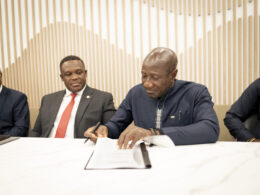
Sulemana Braimah, Executive Director of the Media Foundation for West Africa (MFWA), stood before a virtual PhD seminar at the University of Ghana on February 13 and said what many African media leaders have been thinking but few have articulated so clearly:
“ECOWAS needs to force Big Tech to pay for African news content.”
Not ask. Not negotiate politely. Force.
His proposal: the Economic Community of West African States Commission should develop a binding regional framework that requires platforms like X (Twitter), Facebook/Meta, TikTok, Google, and OpenAI to compensate West African media for content distributed through or consumed via their platforms — including content used to train large language models like ChatGPT, Gemini, and Claude.
The logic is simple: African publishers produce journalism. AI companies scrape that journalism to train models. Those models generate billions in revenue. African publishers get nothing.
Meanwhile, OpenAI is paying Western publishers $1-5 million annually under licensing agreements. The New York Times signed a deal with Amazon. The Guardian licensed content to OpenAI. Associated Press partnered with Google. According to Digiday’s tracking, OpenAI alone has signed 18 licensing deals, Google has 20+, and even Perplexity has 500+ publishers in its revenue-sharing program.
Zero of those deals are with African publishers.
Sulemana Braimah’s proposal is radical not because it demands compensation — that’s obvious. It’s radical because it demands ECOWAS use its collective regional leverage to compel payment, rather than waiting for individual publishers to negotiate from positions of weakness.
And if it works, it could fundamentally reshape the economics of journalism in West Africa. If it doesn’t, African media will continue producing the content that trains billion-dollar AI models while watching their advertising revenue evaporate and their newsrooms collapse.
The AI Training Gold Rush — And Who’s Getting Paid
Let’s start with what’s actually happening in the global AI licensing market, because the numbers are staggering.
According to Digiday‘s comprehensive December 2025 analysis of publisher licensing deals:
OpenAI has signed deals with 18 major publishers globally, including:
- Axios (3-year deal, funding for 4 local newsrooms)
- The Washington Post (summaries, quotes, links in ChatGPT responses)
- The Guardian (attribution + technology access)
- Schibsted Media (Norway-based, access to news in AI summaries)
- News Corp (5-year deal worth over $250 million)
Google has licensed content from 20+ publishers, including:
- Associated Press (real-time news in Gemini chatbot)
- Multiple partners through its Google News Showcase program, now extended to include AI elements
Amazon signed licensing deals with:
- The New York Times (summaries, excerpts, AI model training)
- Condé Nast and Hearst (content for Rufus AI shopping assistant)
Perplexity claims 500+ publishers in its revenue-sharing program, though publishers told Digiday that Perplexity’s payouts are “a fraction of what OpenAI was offering.”
Financial terms vary, but sources familiar with the deals estimate:
- Tier 1 publishers (NYT, WSJ, WaPo): $1-5 million annually
- Mid-tier publishers: $500K-$1M annually
- Smaller publishers: Under $500K or revenue-sharing models
And here’s the kicker: Anthropic just settled a copyright lawsuit for $1.5 billion in September 2025 — the costliest copyright precedent in history — because it trained Claude on pirated books. The settlement established a $3,000-per-work baseline for copyright valuation in AI training contexts, giving publishers concrete negotiating leverage.
The message is clear: AI companies know they need to pay for training data. They’re already paying. Just not in Africa.
Why African Publishers Are Shut Out
Zero African publishers have signed AI licensing deals with OpenAI, Google, Meta, Amazon, or Perplexity. Not one.
Why?
First, negotiating power. Individual African publishers — even major ones like Daily Nation (Kenya), This Day (Nigeria), or Mail & Guardian (South Africa) — lack the brand recognition and scale to command attention from Silicon Valley tech giants. The New York Times has 10 million digital subscribers. No African publisher comes close.
Second, aggregation problem. African media is fragmented. West Africa alone has thousands of outlets across 15 countries, producing content in English, French, Portuguese, and dozens of local languages. AI companies don’t want to negotiate with 1,000 individual publishers. They want one deal that covers entire regions.
Third, legal infrastructure. Most AI licensing deals include complex IP protections, attribution requirements, and revenue-sharing mechanisms that require sophisticated legal teams to negotiate. Many African publishers lack those resources.
Fourth, absence from the conversation. According to multiple sources, African media executives were not invited to early publisher-AI company discussions. By the time they realized licensing deals were happening, the frameworks were already set — and those frameworks assumed Western publishers as the primary content sources.
As Africa Media Festival 2026 concluded in Nairobi this month, African media leaders issued a “strong call for transparency, accountability and ownership in the age of artificial intelligence.” The call was clear: African journalists and creators need to move “beyond content production to controlling platforms, intellectual property and distribution channels.”
But calls for transparency don’t pay newsroom salaries. Binding legal frameworks that force Big Tech to negotiate do.
The ECOWAS Collective Bargaining Strategy
Braimah’s proposal to ECOWAS is modeled on two precedents: Canada’s Online News Act and Australia’s News Media Bargaining Code.
Both laws force digital platforms to compensate news publishers for content distributed on their platforms. Both rely on collective bargaining — publishers negotiate as a bloc, not individually. And both have worked, to varying degrees.
Canada’s approach:
- Passed in June 2023, requires platforms with 20M+ monthly users to pay Canadian news outlets
- Google and Meta initially threatened to block news content in Canada
- After intense government pressure, both signed deals: Google committed $100 million CAD annually to Canadian journalism, Meta blocked news entirely
Australia’s approach:
- Passed in February 2021, allows government to designate platforms and force arbitration
- Google and Meta signed deals worth $200 million AUD annually to Australian publishers
- Threat of regulation drove deals, not goodwill
Both models prove that governments with leverage can force Big Tech to pay. The question is whether ECOWAS has that leverage.
Braimah argues it does. “Acting individually, West African states often lack the bargaining power to influence multinational technology firms,” he said. “Acting collectively through ECOWAS, however, the region could negotiate from a position of strength.”
The math is compelling:
- 15 ECOWAS member states: Benin, Burkina Faso, Cabo Verde, Côte d’Ivoire, The Gambia, Ghana, Guinea, Guinea-Bissau, Liberia, Mali, Niger, Nigeria, Senegal, Sierra Leone, Togo
- Combined population: ~400 million (Nigeria alone: 220 million)
- Digital penetration growing rapidly: Mobile internet usage surging across region
- Strategic importance: West Africa is one of the fastest-growing digital markets globally
If ECOWAS threatened to regulate AI platforms’ access to the West African market — blocking or heavily taxing companies that refuse to compensate publishers — would Google, Meta, and OpenAI comply?
Braimah thinks yes. The alternative — losing access to 400 million people in one of the world’s fastest-growing digital markets — is too costly.
The Structural Crisis Driving the Push
Braimah framed his proposal as a response to what he called “the most existential threat facing journalism in the region: financial collapse.”
The data supports his claim. According to multiple sources:
- Advertising revenue has cratered as digital platforms capture 70-80% of online ad spend
- Newsroom closures are accelerating across West Africa
- Journalist salaries are stagnant or declining, driving talent exodus to PR, NGOs, and government
- Misinformation thrives in the vacuum created by weakened professional journalism
ECOWAS itself has recognized the crisis. Through its Directorate of Communication, ECOWAS has launched training programs to equip journalists with AI-assisted fact-checking, deepfake detection, and digital security protocols. In partnership with the German Development Agency (GIZ) and MFWA, ECOWAS has trained 315 journalists across The Gambia, Sierra Leone, Nigeria, Côte d’Ivoire, Ghana, and Cabo Verde.
But training doesn’t fix structural revenue collapse. Only new revenue streams do.
And if AI companies are making billions by training models on African journalism, African publishers deserve a cut.
The Risks: Can ECOWAS Actually Force Compliance?
The biggest risk to Braimah’s proposal is that ECOWAS lacks enforcement power.
Unlike the European Union, which can impose massive fines and force compliance through regulatory threats, ECOWAS is a regional economic community with limited supranational authority. Its member states often ignore directives, and enforcement mechanisms are weak.
Consider recent precedents:
- ECOWAS threatened military intervention in Niger, Mali, and Burkina Faso after coups. All three countries ignored ECOWAS, withdrew from the bloc, and formed the Confederation of Sahel States.
- ECOWAS has struggled to enforce data protection laws, despite adopting frameworks years ago
- Political instability and military regimes in several member states weaken collective action
So if ECOWAS passes a directive requiring Big Tech to pay publishers, what happens if Google, Meta, and OpenAI just… ignore it?
The Australia/Canada model worked because those governments could credibly threaten to block platforms entirely. ECOWAS member states — many of which depend on Facebook and WhatsApp for political communication and commerce — may not have that credibility.
Braimah acknowledges this. His argument is that collective bargaining at least gives publishers a seat at the table. Right now, they have none.
And if even a few ECOWAS member states — Nigeria, Ghana, Côte d’Ivoire, Senegal — threatened coordinated action, the economic cost to Big Tech would be material enough to force negotiations.
What Happens Next
ECOWAS has not yet responded to Braimah’s proposal. But momentum is building.
At Africa Media Festival 2026, which concluded in Nairobi on March 2, African media leaders issued the strongest call yet for ownership of platforms, intellectual property, and distribution channels. The festival introduced a “Creator for Good Award”, signaling recognition of impact-driven digital storytelling — but also acknowledging that creators need sustainable business models, not just recognition.
The African Union’s Continental AI Strategy includes provisions for intellectual property protection and data sovereignty, but lacks enforcement mechanisms for compelling Big Tech compliance.
And at the policy level, African governments are waking up to the fact that AI regulation is a sovereignty issue. If African data trains Western AI models that generate billions in revenue, but African institutions see none of that value, that’s digital extraction — colonialism rebranded as innovation.
The question is whether ECOWAS will act.
If it does — if it passes a binding framework requiring platforms to compensate publishers, and if member states enforce it — African journalism could gain a lifeline. Not charity. Not grants from UNESCO or GIZ. Structural revenue from the companies profiting off African content.
If it doesn’t, African publishers will continue producing journalism while watching their business models collapse. AI companies will keep training on African content for free. And the next generation of African journalism will be written by whoever can afford to work for nothing — which is to say, nobody.
The Verdict: Leverage or Nothing
Braimah’s proposal is simple: Use collective bargaining to force Big Tech to pay African publishers for content used in AI training and platform distribution.
The precedents exist. Canada and Australia proved it works. The money exists — OpenAI is already paying $1-5 million annually to Western publishers. The legal arguments exist — Anthropic’s $1.5 billion settlement established that using copyrighted content without permission has real cost.
What doesn’t exist yet is the political will.
ECOWAS must decide whether defending African journalism is worth the political capital required to confront Google, Meta, and OpenAI. Member states must decide whether protecting their media ecosystems justifies potential backlash from platforms that could threaten to withdraw services.
And African publishers must decide whether they’re willing to organize collectively — across borders, languages, and competitive rivalries — to negotiate from a position of strength.
Because here’s the uncomfortable truth: Big Tech will not pay African publishers out of goodwill. They will pay if forced. And they will only be forced if African governments act collectively.
The ECOWAS collective bargaining framework could work. Or it could become another well-intentioned proposal that generates headlines but changes nothing.
The difference will come down to whether African leaders believe their journalism is worth fighting for. And whether they’re willing to use the leverage they actually have.
For now, OpenAI keeps training on African news for free. Google keeps indexing African content without compensation. And African newsrooms keep closing.
The question isn’t whether Big Tech should pay. It’s whether ECOWAS has the courage to make them.




Comments 2