Spiro has secured an additional $55 million in equity funding from NewTrails Capital, a Chinese growth-stage investor, lifting the African electric mobility company’s latest funding round to $270 million. The fresh capital arrives just three weeks after Spiro disclosed a $215 million equity raise backed by Impact Fund Denmark and Equitane, a round that was already the largest ever recorded for an African two-wheeled EV company.
With the new commitment, Spiro’s total disclosed funding climbs to roughly $557 million since its founding in 2022. That figure cements its position as the most heavily capitalized electric mobility business on the continent, and it puts the company within reach of unicorn status, with Bloomberg reporting the deal lifts Spiro’s valuation to nearly $1 billion.
Why NewTrails Capital’s Money Matters More Than the Number
The size of the check is notable. The identity of the investor is more interesting. NewTrails Capital is a China-focused growth-stage fund with operations spanning Shanghai, Shenzhen and Nigeria, and its entry deepens a supply chain relationship Spiro already had with Chinese manufacturers. The company has previously sourced batteries through an $11.6 million supply agreement with CBAK Energy Technology, and as of October 2025 reported that 30 percent of the value of its motorcycles was being produced locally.
Yufan Zhang, founding partner of NewTrails Capital, described Spiro as an infrastructure-driven business rather than a vehicle seller, framing its battery-swapping network as part of the continent’s broader energy transition. That framing matters for how the round should be read. Spiro is increasingly being valued the way investors value telecom towers or toll roads, not the way they value a motorcycle assembler. Coverage, not horsepower, is the asset.
A Company That Keeps Returning to the Capital Markets
Spiro’s fundraising pace has been unusual even by the standards of Africa’s e-mobility funding rebound. The company raised $50 million in debt from Afreximbank in February, a $100 million growth round in October 2025, and the $215 million equity raise earlier this month. NewTrails Capital’s $55 million is the fourth disclosed capital event in roughly a year.
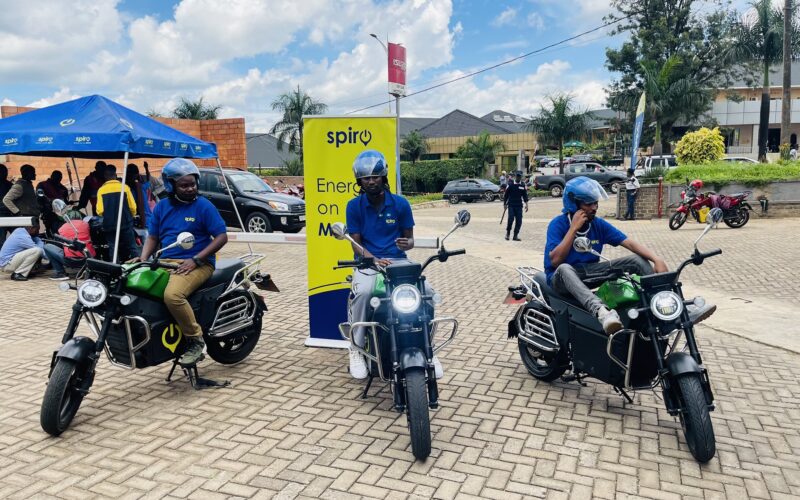
The rapid succession has coincided with operational milestones. Spiro says it has deployed more than 100,000 electric vehicles and built over 2,500 battery-swapping stations across seven markets, including Kenya, Uganda, Rwanda, Nigeria, Cameroon, Benin and Togo, and has logged more than 30 million completed battery swaps. The company also recently appointed former Indofast Energy chief executive Anant Badjatya as group CEO, hiring in someone who previously built a battery-swapping network of more than 1,800 stations in India, one of the most developed markets globally for the technology.
Where the Money Is Actually Going
Spiro intends to deploy the new capital toward battery-swapping infrastructure, manufacturing capacity and energy network expansion in markets where it already operates, with the Democratic Republic of Congo and Ethiopia identified as the next targets. The company has also acquired UK engineering and design firm Coexlion and is planning a research and development centre in Nairobi to build prototypes tailored to African road conditions.
That ambition sits alongside genuine competitive pressure. Kenya’s National E-Mobility Policy has accelerated EV adoption nationally, but it has also lowered the barrier for rivals. Ampersand, Roam and BasiGo are all scaling in the same Kenyan market, and Ethiopian battery-swap startup Dodai has already staked a claim to the Addis Ababa market Spiro is reportedly eyeing next. Chinese manufacturers are also entering African markets directly, which complicates the localization argument that has anchored much of Spiro’s pitch to development finance institutions.
The Question Investors Aren’t Asking Out Loud
Spiro’s infrastructure framing is compelling, but infrastructure businesses are judged on a different timeline than startups. A telecom tower operator can absorb years of capital intensity because regulatory tenure and switching costs protect the asset. Spiro’s battery-swapping network does not yet have that kind of structural protection. Execution risk is concentrated in markets with different import regimes, currency exposure and regulatory unpredictability, particularly in Nigeria, where policy shifts can move faster than infrastructure build-out.
The deeper question is whether half a billion dollars in disclosed funding has actually been matched by proportional revenue generation, or whether Spiro is still substituting capital for unit economics that have not yet been proven at scale. NewTrails Capital’s Zhang called Spiro an early-stage company within a long-term thesis. Investors writing nine-figure checks every few months are betting that statement is true. The riders using Spiro’s bikes, and the competitors racing to out-build its swap network, will determine whether it holds.