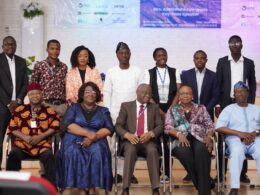
Ghana’s Communication, Digital Technology and Innovations Minister, Samuel Nartey George, will lead the African Union’s technical committee on ICT for the next two years. Ministers confirmed him unanimously as AU ICT committee chair at the sixth ordinary session of the Specialised Technical Committee on Communication and ICT (STC-CICT) in Libreville, Gabon. His term runs from October 2026, according to 3News.
The chair’s powers are advisory but not trivial. The committee’s bureau steers deliberations and builds consensus among member states, the AU Commission said. Its recommendations then go to AU policy organs and feed continental strategies on digital transformation, communications infrastructure and emerging technologies.
Who the Chairmanship Affects
Delegates elected a five-region bureau when the session opened on October 26. Ghana chairs for West Africa, Kenya is first vice-chair for East Africa, and host Gabon is third vice-chair for Central Africa. Lesotho serves as rapporteur for Southern Africa. The North African seat of second vice-chair is still to be confirmed.
Kenya, which holds the first vice-chair, has strengthened its cybersecurity partnership with the UK, TechMoonshot reported earlier this month. Cybersecurity is one of the four priorities George named in Libreville.
The decisions that follow reach operators, regulators, cloud providers and startups that sell across borders. Aline Sylvie Minko-Mi-Etoua, secretary general of Gabon’s digital economy ministry, told the opening session that recommendations must suit every member state, whatever its resources. Robert Lisinge of the UN Economic Commission for Africa said connectivity gains need reliable infrastructure and affordable access, according to the AU.
What George Promised in Libreville
George described the post as a responsibility to the whole union, not a privilege for Ghana, according to 3News. He said Africa must move beyond policy declarations to implementation. Connectivity, data governance, cybersecurity and artificial intelligence, he added, need urgent and coordinated action.
He also called for a single African voice in global negotiations on AI, data and digital trade. Africa’s population of nearly 1.5 billion gives it leverage, he argued. “Africa must be at the table, not on the menu,” he said. He told delegates the committee’s record over the next two years must be judged on tangible outcomes.
The campaign began months earlier. In March, George sent the AU a letter of intent after clearing the move with President John Mahama, who is due to chair the AU in 2027, B&FT reported. He argued that Ghana could use the role to press for digital trade frameworks under the African Continental Free Trade Area. On September 7, he told an Accra accountability forum that he had been unanimously confirmed as next chair, MyJoyOnline reported.
A Crowded Rulebook for African AI
The AI file will test him first. The AU held a consultation in September to advance its Continental AI Strategy, and GSMA’s Angela Wamola urged a continental baseline rather than identical laws, according to TechAfrica News. The AU is preparing draft guidelines and a model law for ministerial review, the outlet reported.
Any model law must fit alongside Smart Africa’s Model AI Policy Framework, which launched in Geneva in 2025 to guide countries without national AI strategies. TechMoonshot’s country-by-country tracker found that 16 of 54 countries had published national AI strategies or frameworks by April 2026. Ghana’s own AI governance rests on its strategy document and the data protection authority created under the 2012 Data Protection Act.
Accountability Questions for Ghana
A chair gets judged at home first. Ghana scrapped its single-network 5G plan this year. According to the National Communications Authority (NCA), Next Gen Infraco had 49 5G sites by March against a target of 1,200 by 2027, and the regulator removed its exclusivity on July 15. MTN Ghana has since paid $202 million for 5G spectrum, TechMoonshot reported.
George’s AI pledges face the same test. On October 21, he outlined a $270 million AI plan, with $250 million for infrastructure and computing capacity and $20 million as seed funding for an AI fund, GhanaWeb reported. The plan includes a national language model so public institutions avoid exposing sensitive data to foreign platforms. George also questioned how effective Ghana’s data residency law can be if state bodies keep using foreign AI models. Delivery will matter more than the headline number.
The structural limit sits above Ghana. The committee recommends, and member states decide whether to act. Kanono Ramashamole, the Lesotho official who addressed the opening session as outgoing chair, said consensus among 55 member states is “neither easy nor automatic,” according to the AU. George named the same gap himself when he said Africa must move from declarations to implementation.
Three Markers to Watch Over George’s Two-Year Term
Three markers will show whether the chairmanship moves anything. The first is the AU’s draft AI guidelines and model law, which head to ministerial review. The second is Accra’s hosting of the 15th Africa Internet Governance Forum in November, MyJoyOnline reported. The third is Ghana’s seat on the Council of the African Telecommunications Union for 2027 to 2030, which George announced.
Mahama’s turn at the AU helm in 2027 gives George a political tailwind. George has said the committee should be judged by tangible outcomes. As AU ICT committee chair, he now has two years to supply them.