



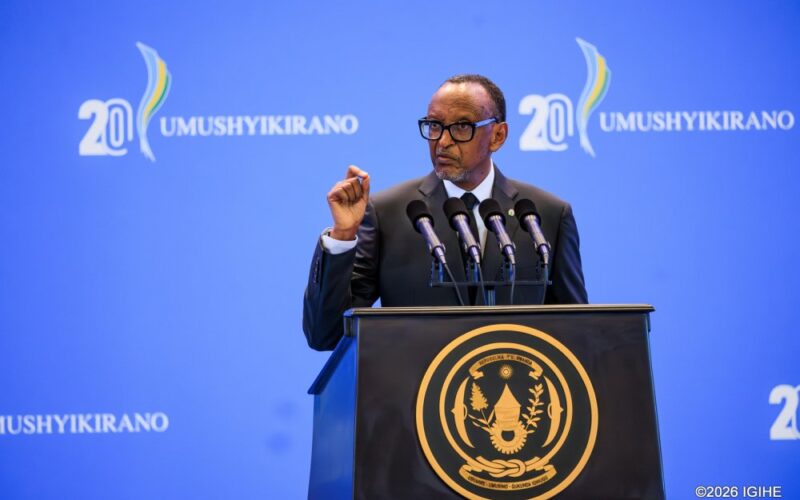
On February 5-6, 2026, during Rwanda’s 20th National Umushyikirano Council—an annual national dialogue where citizens can directly petition President Paul Kagame—Rwandan musician Bruce Melodie stood up and made a plea that resonated across the continent.
“We ask the government to help us monetize these social media platforms for people who produce meaningful content,” he said. “Most work today is done on social media. On TikTok, people in other countries earn a lot of money, but for us Rwandans, we sometimes have to use other nationalities in order to access income from these platforms.”
Within days, social media was flooded with posts claiming Rwanda had become the first African country to unlock direct TikTok monetization. CreatorInsider Africa, influencer accounts, and tech blogs reported that Rwandan creators could now earn money directly from their content through TikTok’s Creator Rewards Programme.
Then, on February 19, Rwanda’s Ministry of ICT and Innovation issued a statement denying the claims entirely.
“The Ministry… wishes to clarify that TikTok monetization has not yet been launched in Rwanda,” the ministry said, calling the viral reports “inaccurate.”
So what actually happened? Did Rwanda secure TikTok monetization or not? And why does the confusion matter for Africa’s 1.3 billion people trying to participate in the global creator economy?
The answer is more complicated than either the celebratory posts or the government denial suggest. And it exposes a structural problem that no single African government can solve alone.
What TikTok Monetization Actually Requires
To understand the Rwanda confusion, you need to understand how TikTok determines which countries get access to direct monetization.
According to Paula Ingabire, Rwanda’s Minister of ICT and Innovation, who responded directly to Bruce Melodie’s question during the Umushyikirano Council, TikTok requires three conditions before activating monetization in any country:
- Regulatory compliance — The country must have data protection laws, payment infrastructure, and tax frameworks that TikTok can operate within
- Payment processor availability — TikTok uses platforms like Stripe and PayPal to disburse creator earnings. If those processors don’t operate in a country, TikTok can’t pay creators
- Sufficient advertising investment — TikTok’s monetization model depends on advertisers buying ad inventory. If businesses in a country aren’t spending enough on TikTok ads, the platform won’t enable creator payouts
Rwanda, according to Ingabire, has met the first two requirements. The sticking point is the third: advertising revenue.
“Stronger collaboration between the private sector and digital platforms could help Rwanda meet the remaining requirement,” she said.
Translation: Rwanda has the legal and technical infrastructure for TikTok monetization. What it lacks is enough businesses buying TikTok ads to make creator payouts financially sustainable for the platform.
That’s not Rwanda’s fault. It’s a chicken-and-egg problem that affects most African markets.
The Chicken-and-Egg Problem Keeping Africa Locked Out
Here’s the trap:
TikTok won’t enable monetization until advertisers spend more.
Advertisers won’t spend more until there’s proof of ROI.
There’s no proof of ROI because most African TikTok users can’t buy products advertised to them.
Users can’t buy because e-commerce infrastructure, payment rails, and logistics are weak.
E-commerce won’t invest in TikTok because monetized creators aren’t driving commerce yet.
Creators can’t drive commerce because they’re not monetized.
It’s a closed loop. And the only way to break it is for someone — either TikTok, governments, or a coalition of both — to take a loss upfront to kickstart the ecosystem.
Rwanda’s government, to its credit, is trying. At the Umushyikirano Council, President Kagame asked the right follow-up question: “What requirements must be met for Rwandan users to benefit from monetization programs without needing to register accounts under foreign countries?”
That acknowledgment — that Rwandan creators are already gaming the system by using foreign accounts — is significant. It means the government recognizes the problem and is willing to engage.
But recognition isn’t the same as solving it. And solving it requires TikTok to do something it’s historically been reluctant to do: enable monetization in markets where advertising spend doesn’t yet justify it.
Who Actually Has TikTok Monetization in Africa (And Who Doesn’t)
As of March 2026, only three African countries have access to TikTok’s Effect Creator Rewards program, which allows creators to earn from effects and filters:
Zero African countries are eligible for TikTok’s Creator Fund, which pays based on video performance (views, engagement). The Creator Fund operates only in:
- United States
- United Kingdom
- Germany
- France
- Brazil
- Japan
- South Korea
That means 51 out of 54 African countries have no access to direct TikTok monetization of any kind.
For context, TikTok’s monetization programs operate in 53 regions globally. Africa, with 1.3 billion people and over 100 million TikTok users, accounts for just 3 of those 53 regions (and only for limited programs, not the full Creator Fund).
The exclusion is even starker when you compare Africa to other markets:
Latin America: Brazil has Creator Fund access. Other countries have partial monetization.
Asia: Japan, South Korea, India (before the ban), Philippines, Indonesia, Thailand all have various monetization options.
Middle East: Saudi Arabia, UAE, Qatar have access to creator programs.
Africa: Three countries, limited programs, zero Creator Fund access.
This isn’t an accident. It’s a reflection of where global advertising budgets flow. And African markets, despite their population size and growth rates, are not capturing enough ad spend to justify TikTok’s investment in monetization infrastructure.
What African Creators Do Instead (And Why It’s Inadequate)
In the absence of direct monetization, African TikTok creators earn through:
1. Brand partnerships — Companies pay creators to promote products in videos. But this requires an existing large following and business connections.
2. Music artist collaborations — Musicians pay creators to promote new releases. This works if you’re in entertainment ecosystems (Nigeria, South Africa, Kenya). Elsewhere, it’s scarce.
3. Creator Rewards (limited markets) — Available only in Morocco, Egypt, South Africa for specific programs.
4. Gifts during live streams — Viewers send virtual tokens that convert to money. But gift payouts are low, and the feature requires strong viewer engagement.
5. Subscriptions — Fans pay monthly fees for exclusive content. But African payment rails (mobile money, card infrastructure) make subscriptions harder to implement than in Western markets.
6. Using foreign accounts — Many African creators register accounts using European or American addresses to access monetization. This is what Bruce Melodie referenced during his appeal.
That last method — faking foreign residency — is widespread but problematic. It requires VPNs, foreign bank accounts or payment processors, and constant risk of account suspension if TikTok detects fraud.
And it highlights the absurdity: African creators produce content that TikTok profits from (through ad revenue from African viewers), but those creators can’t access the earnings that creators in Europe and North America receive for the exact same work.
Why the Rwanda Confusion Happened—And What It Reveals
So why did social media claim Rwanda got monetization when the government says it didn’t?
Most likely: confusion between different types of TikTok access.
Some sources may have confused:
- Effect Creator Rewards (for effects/filters, available in 53 regions) with
- Full Creator Fund (for video performance, available in 7 countries) with
- Gifts and Subscriptions (available in more markets but not direct monetization)
Or, creators may have started seeing incremental features unlock — like improved gift payouts or beta access to new tools — and interpreted that as full monetization.
The Ministry’s denial clarified that official, government-acknowledged monetization has not launched. But it’s possible that individual creators are experiencing changes that feel like monetization without Rwanda being officially added to TikTok’s approved regions list.
What the confusion reveals is how desperately African creators want access. The fact that a single comment at a national council sparked continent-wide celebration shows how starved the ecosystem is for recognition and opportunity.
What Would Actually Fix This (And Why It’s Hard)
Fixing Africa’s TikTok monetization problem requires action from three parties:
1. TikTok must either:
- Lower the advertising threshold for African markets (accept lower ad spend in exchange for long-term growth)
- Pilot monetization in 5-10 African markets simultaneously (Rwanda, Ghana, Nigeria, Kenya, Senegal, Côte d’Ivoire) to create critical mass
- Partner with African payment processors (Flutterwave, Paystack, Chipper Cash) instead of waiting for Stripe/PayPal
2. African governments must:
- Negotiate collectively (via African Union or ECOWAS) rather than individually — one country has no leverage, 15 countries do
- Incentivize local businesses to advertise on TikTok (tax breaks, co-marketing programs)
- Build regulatory frameworks that make it easy for platforms to operate (data protection, payment licensing, tax clarity)
3. African businesses must:
- Increase TikTok ad spend (currently, most marketing budgets go to Facebook, Instagram, Google)
- Test TikTok commerce (shoppable videos, live-stream selling) to prove ROI
- Support creator partnerships that drive actual sales
None of this is easy. And none of it happens quickly.
But the alternative — where 1.3 billion Africans remain locked out of the creator economy while producing content that generates billions for platforms — is unsustainable.
The Verdict: Rwanda Didn’t Get Monetization. But the Conversation Matters.
No, Rwanda has not officially secured TikTok monetization as of March 2026. The Ministry of ICT’s denial is clear.
But the conversation that Bruce Melodie sparked at the National Umushyikirano Council is more valuable than any single country’s monetization status.
Because the problem isn’t Rwanda-specific. It’s continental. And solving it requires African governments, platforms, and businesses to recognize that creator economies are real economies — they generate income, create jobs, and drive commerce.
When a Rwandan musician has to fake American residency to earn from his work, that’s not just inconvenient. It’s a market failure. And market failures, when left unaddressed, compound.
So here’s what needs to happen next:
For TikTok: Pilot monetization in 5 African markets by Q4 2026. Measure results. Expand based on data. Stop treating 1.3 billion people as “not ready” when the real barrier is your advertising threshold.
For African governments: Form a collective negotiating bloc. Present TikTok with a unified proposal: monetization for 10-15 markets in exchange for regulatory clarity and government co-marketing support.
For African creators: Keep creating. Keep building audiences. And keep making noise. Bruce Melodie’s question at the Umushyikirano Council didn’t unlock monetization. But it put the issue on President Kagame’s agenda. That’s how change starts.
Rwanda may not be the first African country with TikTok monetization. But if its government keeps pushing, and if other African nations join the effort, it could be part of the coalition that forces TikTok to finally treat African creators as equals.
Which African country is next? Whichever one organizes its creators, businesses, and government into a unified push. Because TikTok won’t give this away. It will have to be taken. And that requires leverage, coordination, and persistence.
The confusion around Rwanda’s status proves one thing: African creators are ready. The question is whether the platforms and governments will catch up.



Comments 3