



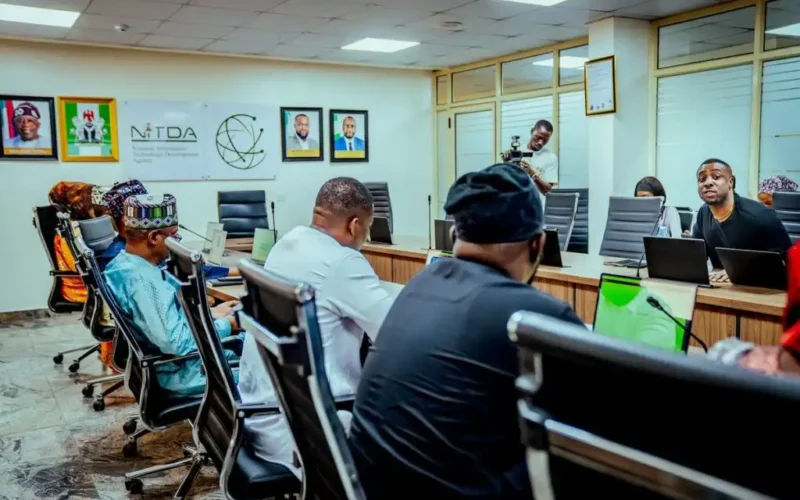
On February 28, 2026, the National Information Technology Development Agency (NITDA) hosted a strategic engagement with NKENNEAi, an African language artificial intelligence platform, to formalize a partnership that could reshape how AI understands African languages.
The collaboration focuses on building scalable translation and language technologies capable of supporting:
- Government services (multilingual citizen interfaces)
- Healthcare systems (patient communication in local languages)
- Financial platforms (banking in Yoruba, Hausa, Igbo)
- Digital applications (chatbots, voice assistants, customer service)
The challenge is real: Nigeria has over 500 languages. Traditional AI models—trained primarily on English, Mandarin, Spanish—struggle with tonal African languages where a single word’s meaning shifts based on pitch, context, and cultural nuance. Google Translate works for Swahili basics. It fails spectacularly for Yoruba idioms or Igbo proverbs.
Dr. Bunmi Ajala, National Director of the National Centre for Artificial Intelligence and Robotics (NCAIR), outlined NITDA’s ambitious goals during the engagement:
- 70% digital literacy by 2027
- Strong AI talent pipeline
- AI integrated into public service delivery
- High-performance infrastructure (GPUs, TPUs, GovNet initiative)
For Michael Odokara-Okigbo, CEO of NKENNEAi, the partnership validates a bet he’s been making since 2020: African languages aren’t just worth preserving—they’re worth building AI infrastructure around.
“NKENNE started as a cultural mission to help preserve and teach African languages,” Odokara-Okigbo said. “As our community grew to hundreds of thousands of learners, we realized the data and linguistic insights we were building could power something far bigger. NKENNEAi is about building the infrastructure that allows African languages to exist, scale, and thrive inside artificial intelligence systems.”
This isn’t aspirational. It’s operational. And if it works, Nigeria could become the first African country with indigenous AI infrastructure designed for its own linguistic complexity—not retrofitted from Western models.
The Journey: From Language Learning App to AI Infrastructure Platform
Michael Odokara-Okigbo didn’t set out to build AI infrastructure. He set out to learn Igbo.
Born in the United States to Nigerian parents, Odokara-Okigbo grew up in Portland, Maine, disconnected from his mother tongue. During the 2020 pandemic lockdown—while his music tour was postponed—he searched for an app to learn Igbo.
There wasn’t one.
So he built NKENNE (which means “of the mother” in Igbo)—a community-based language learning platform focused on African languages. Not Duolingo with Swahili added as an afterthought. A platform designed specifically for the tonal, contextual, and culturally rich nature of African languages.
The early traction was slow. Then explosive:
- 2021: NKENNE launched
- 2022: Named Apple’s App of the Day
- 2023: 50,000 users; awarded $1 million NSF grant to develop tonally-sensitive AI translation
- 2024: Expanded to 20 languages; opened 4th office in Ibadan, Nigeria
- 2025: 400,000+ users worldwide; launched NKENNEAi as separate AI infrastructure platform
- 2026: Partnership with NITDA to integrate AI into Nigerian government services
Today, NKENNE teaches:
- Igbo, Yoruba, Hausa (Nigeria’s three major languages)
- Swahili (East Africa)
- Twi (Ghana)
- Somali (Somalia)
- Nigerian Pidgin (Nigeria’s most widely spoken language)
- 13+ other African languages
Users learn through music, games, storytelling, and live tutoring. The platform employs 13 native-speaking instructors in Ibadan for real-time lessons. And crucially, every lesson, every conversation, every voice recording generates linguistic data that feeds NKENNEAi’s machine learning models.
That data—hundreds of thousands of hours of tonal African language speech—is what makes NKENNEAi different from Google Translate or OpenAI’s Whisper. It’s not retrofitted. It’s purpose-built.
How NKENNEAi Actually Works: Tonally-Sensitive AI Translation
Most global AI models struggle with African languages for three reasons:
1. Lack of training data
Western AI systems are trained on billions of English, Spanish, and Mandarin sentences. African languages have low-resource datasets—sparse text corpora, limited speech recordings, few annotated examples.
2. Tonal complexity
In Yoruba, the word “igba” can mean 200, calabash, or garden egg—depending on tone. Western AI models trained on non-tonal languages miss these distinctions entirely.
3. Cultural context
African languages embed cultural meaning that direct translation can’t capture. Idioms, proverbs, kinship terms—these require understanding social context, not just grammar.
NKENNEAi addresses all three:
On data scarcity: NKENNE’s 400,000+ users generate massive amounts of linguistic data—text, speech, corrections, contextual usage. That corpus feeds machine learning models specifically designed for African languages.
On tonal sensitivity: NKENNEAi’s models are trained to recognize pitch patterns, intonation, and tonal shifts that change meaning. The system doesn’t just translate words—it translates tonal intent.
On cultural context: By embedding cultural context into training data (proverbs, idioms, social structures), NKENNEAi’s models produce translations that sound natural to native speakers, not awkward approximations.
The platform currently supports:
- Text-to-text AI translation (written language conversion)
- Speech-to-text transcription (voice recognition in African languages)
- Text-to-speech voice synthesis (natural-sounding voice output)
- Multilingual AI APIs (for developers to integrate African language support into apps)
These aren’t consumer-facing features. They’re infrastructure—APIs that governments, fintechs, healthtech platforms, and enterprises can use to make their services multilingual without building their own language models.
The NITDA Partnership: What It Actually Means
The NITDA-NKENNEAi partnership isn’t a one-time grant. It’s a multi-year collaboration with staged deployment:
Phase 1: Pilot Integrations (2026)
- Deploy NKENNEAi’s translation APIs in select government agencies
- Test real-time translation for citizen services
- Evaluate accuracy, latency, and user experience
Phase 2: Language Expansion (2026-2027)
- Add more Nigerian languages beyond Yoruba, Hausa, Igbo
- Include minority languages and regional dialects
- Build datasets for underrepresented tongues
Phase 3: Workforce Training (2027)
- Train Nigerian developers to build on NKENNEAi’s APIs
- Equip government IT teams to maintain language AI systems
- Create local AI talent pipeline (aligned with 3MTT Programme)
Phase 4: National Language AI Infrastructure (2027-2028)
- Build unified language AI layer for all Nigerian government services
- Enable multilingual access to healthcare, education, finance, legal systems
- Position Nigeria as African leader in language AI infrastructure
Kashifu Inuwa, Director-General of NITDA, has emphasized that this aligns with Nigeria’s broader AI strategy led by Dr. Bosun Tijani, Minister of Communications, Innovation and Digital Economy. Before joining government, Tijani co-founded Co-Creation Hub (CcHUB), one of Africa’s most influential tech innovation centers.
NITDA is also supporting infrastructure through:
- GPUs and TPUs (Graphics Processing Units, Tensor Processing Units) for AI compute
- GovNet (secure government-wide digital connectivity)
- N-ATLAS (Nigerian Atlas for Languages & AI at Scale—launched September 2025 at UNGA)
N-ATLAS, developed through collaboration between NITDA, NCAIR, and Awarri Technologies, is an open-source multilingual language model trained on Yoruba, Hausa, Igbo, and Nigerian-accented English. NKENNEAi’s partnership complements N-ATLAS by providing commercial-grade translation APIs that businesses can integrate immediately.
The Broader Context: Nigeria’s AI Strategy and Digital Literacy Push
The NITDA-NKENNEAi partnership isn’t happening in isolation. It’s part of Nigeria’s aggressive push to become Africa’s AI hub.
Key initiatives:
1. National AI Strategy (2024)
- Co-created with startups, innovators, industry stakeholders (not dictated top-down)
- Focus on local AI capabilities, sovereign data platforms, responsible governance
- Aligned with African Union Continental AI Strategy
2. 70% Digital Literacy by 2027
- Government target led by NCAIR
- Requires multilingual digital services (you can’t achieve digital literacy if services are only in English)
- Language AI is infrastructure, not luxury
3. 3 Million Technical Talent (3MTT) Programme
- Training 3 million Nigerians in AI, data science, cloud computing, cybersecurity
- Creates local talent pipeline to build on platforms like NKENNEAi
4. AI Research Grants
- NITDA offering grants to startups, researchers, universities
- Funded through AI Research Grant (AIRG) programme
- NKENNEAi has received multiple NSF grants ($1M+ from U.S. National Science Foundation)
Nigeria’s approach is notable because it’s not waiting for Google, Meta, or OpenAI to add African languages. It’s building indigenous infrastructure—and betting that local solutions will outperform Western retrofits.
The Risks: What Could Go Wrong
Building African language AI infrastructure is ambitious. It’s also fragile. Here are the structural risks:
1. Data Quality and Quantity
Even with 400,000 users, NKENNE’s dataset is tiny compared to the billions of sentences that train models like GPT-4 or Gemini. Low-resource languages require creative data augmentation—but if models are trained on insufficient data, translation quality degrades.
2. Sustainability
Government partnerships are great for validation. They’re terrible for long-term revenue. If NKENNEAi depends on NITDA contracts but can’t build commercial traction with fintechs, healthtech, and enterprises, the business won’t scale.
3. Compute Costs
Training tonally-sensitive AI models requires massive compute (GPUs, TPUs). Nigeria’s infrastructure gaps—power reliability, cloud access, connectivity—make AI research expensive. Without reliable compute, development slows.
4. Brain Drain
Nigeria produces talented AI engineers. Many leave for Google, Meta, OpenAI. If NKENNEAi can’t compete on compensation and opportunities, talent migrates to better-funded Western companies.
5. Linguistic Complexity
Nigeria has 500+ languages. Even if NKENNEAi masters Yoruba, Hausa, and Igbo, that covers maybe 60% of the population. Reaching full linguistic inclusion requires building models for hundreds of minority languages—an enormous undertaking.
The Verdict: A Necessary Bet on Linguistic Sovereignty
The NITDA-NKENNEAi partnership isn’t just about translation. It’s about linguistic sovereignty—the ability to build AI systems that work in African languages without depending on Western tech giants.
Here’s why it matters:
1. Digital Inclusion
You can’t achieve digital literacy if government services, healthcare apps, and financial platforms only work in English. Language AI is infrastructure for inclusion.
2. Cultural Preservation
Languages die when they’re not used. If AI systems only speak English, African languages will disappear from digital spaces—and eventually from everyday life.
3. Economic Opportunity
If African languages become machine-readable, Nigerian startups can build products for African markets without waiting for Google to add Yoruba support. That’s competitive advantage.
4. Talent Retention
Building indigenous AI infrastructure creates local jobs for Nigerian engineers. If NKENNEAi scales, top talent stays home instead of migrating to Silicon Valley.
The risks are real. NKENNEAi could fail to scale. NITDA could deprioritize the partnership. Compute costs could make development unsustainable.
But the alternative—waiting for Western AI companies to care about Nigerian Pidgin—guarantees failure.
Michael Odokara-Okigbo didn’t wait. He built NKENNE when no one else would. Now, with NITDA’s backing, he’s building the infrastructure that could make African languages survive the AI era.
Whether it works depends on execution. But the fact that Nigeria is trying—building indigenous AI infrastructure instead of just consuming Western models—is itself a strategic victory.
Because the future of African languages won’t be decided in Mountain View or Seattle. It will be decided in Abuja, Ibadan, and Lagos—by founders, engineers, and governments willing to bet that Africa’s linguistic diversity is an asset, not a liability.
NKENNEAi currently supports Yoruba, Igbo, Hausa, Swahili, and Nigerian Pidgin, with plans to expand across 20+ African languages. NKENNE has 400,000+ users globally and has received multiple grants from the U.S. National Science Foundation.




Comments 1