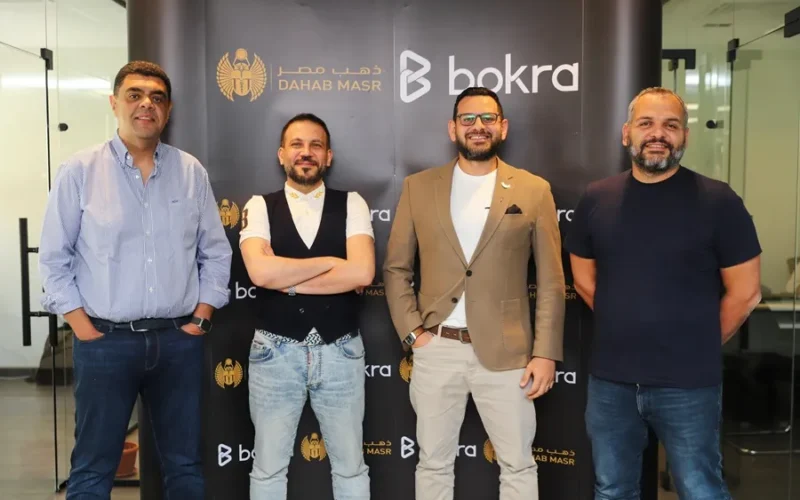
Egyptian fintech Bokra has secured venture capital (VC) and private equity (PE) licences from Egypt’s Financial Regulatory Authority (FRA), positioning the Cairo-based startup to compete directly with traditional fund managers and banks.
The move allows Bokra to deploy capital into high-growth companies using Sharia-compliant, revenue-based financing models—a structure that has remained largely underdeveloped across African markets despite rising demand for alternatives to equity funding.
This milestone reinforces a broader shift already underway in the region, where North Africa recorded strong deal activity throughout 2025, even as macroeconomic pressures reshape how startups raise capital.
Bokra’s Rapid Growth from Savings App to Investment Platform
Founded in 2023 by Ayman Elsawy, Bokra began as a goal-based savings and investment platform offering retail users fractional access to asset-backed securities such as sukuk.
Its early model focused on accessibility—bringing instruments typically reserved for institutional investors to everyday users in Egypt’s fragmented wealth management market.
That positioning aligned with a wider trend across African fintech, where startups are increasingly building alternative financial infrastructure rather than replicating traditional banking models—a shift explored in TechMoonshot’s coverage of emerging platforms across the continent.
Bokra’s traction reflects that demand:
2,000+ first-time sukuk investors
45,000+ users onboarded
From Retail Fintech to Institutional Sukuk Issuer
Bokra’s transition into institutional finance became clear in early 2025 when it structured a EGP 3 billion ($58.9 million) Mudaraba sukuk.
The deal:
- Was executed for Aman Project Finance (Aman Holding)
- Attracted participation from major Egyptian banks
- Received a BBB+ rating from MERIS
- Listed on the Egyptian Stock Exchange
This positioned Bokra in a space traditionally dominated by large corporates and state-backed entities—highlighting how fintechs are beginning to move upstream into capital markets.
It also builds on Bokra’s earlier expansion into commodities investing, when the company launched a platform for gold and precious metals investing—a move that signaled its ambition beyond retail savings.
Revenue-Based Financing in Egypt’s Startup Ecosystem
Bokra’s core differentiator is its focus on revenue-based financing (RBF).
Instead of taking equity, the company provides capital in exchange for a percentage of future revenue—aligning investor returns with actual business performance.
This model was tested through its $3 million deployment into iSupply, an Egyptian pharmacy distribution platform.
The timing is critical.
Egyptian startups are operating in a constrained funding environment shaped by:
Slower venture capital inflows
Currency devaluation
High interest rates
As a result, alternative funding models are gaining traction across the continent. TechMoonshot recently noted that Africa’s fintech consolidation is accelerating—a trend that could reshape how capital flows to early-stage companies.
In that context, RBF offers a more resilient structure, particularly in volatile markets where equity pricing becomes difficult.
New VC and PE Licences Unlock Fund Strategy
With FRA approval, Bokra can now formally launch and manage regulated investment funds.
Its pipeline includes:
- A medical devices export fund
- A household appliances manufacturing fund
- A gold-focused investment vehicle (“El Shakmagia”)
In parallel, the company is preparing a EGP 10–15 billion sukuk issuance pipeline expected by Q3 2026.
This effectively positions Bokra as a hybrid between:
A quasi-investment bank
A fintech platform
An asset manager
Execution Risk and Market Realities
The scale of Bokra’s ambition introduces a key question: execution.
The company is simultaneously expanding across:
- Retail investing
- Startup financing
- Fund management
- Capital markets issuance
At the same time, Egypt’s regulatory environment remains complex. As previously reported, Egyptian fintech startups often face layered approval processes that can slow product rollouts compared to other African markets.
There is also the issue of market depth.
Revenue-based financing works best in ecosystems with a strong base of revenue-generating startups. But if consolidation continues to concentrate market power among a few dominant players, the pipeline of viable RBF candidates could narrow.
A Regulatory Signal for Africa’s Alternative Finance Future
Despite these challenges, the significance of Bokra’s licences extends beyond the company itself.
The FRA’s decision signals a willingness to:
- Institutionalize alternative financing models
- Expand beyond traditional banking frameworks
- Support fintech-led capital innovation
If Bokra can successfully deploy and return capital, it could redefine how startups across Egypt and North Africa access funding—shifting toward performance-linked financing models that reduce dilution and align incentives more closely with business outcomes.
For a region navigating currency volatility and constrained venture funding, that shift could prove structural rather than cyclical.