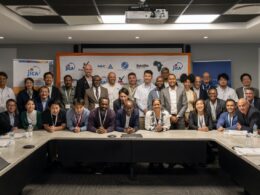
Nigeria’s Federal Ministry of Education has reopened applications for the second cohort of its Student Venture Capital Grant, offering up to ₦50 million in equity-free funding to 50 student-led ventures from a total pool of ₦2.5 billion. The National Coordinator of the ministry’s Special Programme Operations and Implementation Unit, Adebayo Onigbanjo, announced the opening at a press briefing in Abuja on September 4, with the application window closing September 30.
The programme, branded the Next Moonshot Initiative, is a flagship component of the Tinubu administration’s education agenda, positioned as a pipeline for turning campus-based ideas into registered, scaling businesses without founders giving up equity.
Who Qualifies and What Changes This Round
The grant targets full-time students in Science, Technology, Engineering, Mathematics and Medical Sciences, commonly abbreviated STEMM, from 300 level upward, alongside master’s and PhD candidates. Eligible applicants must run federal-, state-, or private-accredited tertiary institutions and typically need a CAC-registered business to advance past the early screening stage.
To widen reach beyond Nigeria’s usual cluster of well-networked universities, the ministry is running a nationwide roadshow from September 6 to 30 across nine institutions: the University of Abuja, Nile University, Abubakar Tafawa Balewa University, Bayero University Kano, Kano University of Science and Technology, Federal Polytechnic Kaduna, Ambrose Alli University, the University of Lagos, and Covenant University. A Campus Ambassador Programme extends awareness to 20 additional schools.
Winning ventures will also get six months of mentorship from corporate partners including Lafarge, Cellulant, Co-Creation Hub, LifeBank, Future Africa, and Get Equity. Applications go through what the ministry calls a hybrid evaluation model: AI-assisted screening for eligibility and completeness, followed by review from ten human evaluators before a final panel stage.
“Successful applicants will be eligible to receive up to ₦50 million equity-free grant from the Federal Republic of Nigeria,” Onigbanjo said, describing the structure as designed to let founders retain full ownership while scaling.
What Cohort One Actually Delivered
The first cohort offers a useful stress test for what Cohort 2 applicants should expect. Launched in November 2025 with a ₦3 billion pool in partnership with the Bank of Industry, that round drew 30,639 applications from 404 tertiary institutions nationwide — evidence of genuine demand for non-dilutive capital in a market where grants remain scarce relative to founder need.
From that pool, the ministry shortlisted just 65 finalists in March 2026, who then went through a four-day venture development bootcamp before 45 ultimately walked away with a combined ₦2.2 billion at an awards ceremony in Lagos. The math is stark. Fewer than 0.15% of applicants received funding, a conversion rate that puts the programme closer to a highly selective fellowship than a broad-based support scheme.
That selectivity is not necessarily a flaw. Pitch competitions and small grants elsewhere on the continent operate on similarly tight funnels, and a ₦50 million cheque at the idea or early-commercialisation stage is a meaningfully larger sum than most comparable programmes offer. But it does mean the roadshow’s nine-institution footprint, plus 20 campus ambassadors, still leaves the vast majority of Nigeria’s 404-plus tertiary institutions without direct outreach, relying instead on word of mouth and social media to reach students outside the usual flagship universities.
A Shorter Window and a Wider Question
Cohort 2’s application period is also considerably tighter than the first round’s. Applications for Cohort 1 stayed open for roughly ten weeks, from mid-November through late January. Cohort 2 gives applicants just 26 days, a compression that could favour students who already have a registered business and a polished pitch deck over first-time founders still refining an idea — precisely the population a government-backed, equity-free grant is meant to reach.
The timing also lands against a backdrop that TechMoonshot has covered closely: Nigeria’s 2026 Appropriation Bill cut the Federal Ministry of Communications, Innovation and Digital Economy’s allocation by more than 80% from the previous year, even as officials continue to frame digital transformation as central to economic strategy. The Student Venture Capital Grant sits under the Ministry of Education rather than the Digital Economy ministry, so it is insulated from that specific cut. Still, the contrast between a headline-grabbing ₦2.5 billion student grant and a shrinking budget for the ministry meant to build the infrastructure those student ventures will eventually depend on is the kind of tension the Renewed Hope Agenda has yet to resolve.
Nigeria has leaned on this playbook before. Programmes like the Lagos State Innovation Bill’s proposed research and development fund and the federal government’s Creative Economy Development Fund follow a similar pattern: announce a large headline figure, run a competitive selection process, and disburse a fraction of it to a small cohort of winners. The model works for the founders who make it through. Whether it moves the needle on Nigeria’s broader youth unemployment and innovation gap depends on execution the ministry has not yet been forced to fully account for in public.
What happens after the ₦50 million lands is also thin on public record. Cohort 1 produced named winners across universities including the Federal University of Agriculture, Abeokuta and the University of Lagos, but there is no published tracking of survival rates, revenue growth, or job creation among the 45 recipients months later. For Cohort 2 applicants weighing whether to spend the next three weeks preparing a submission, that absence of outcome data is arguably as relevant as the grant amount itself.
Applications for Cohort 2 close on September 30, 2026, through the Ministry of Education’s dedicated portal.