


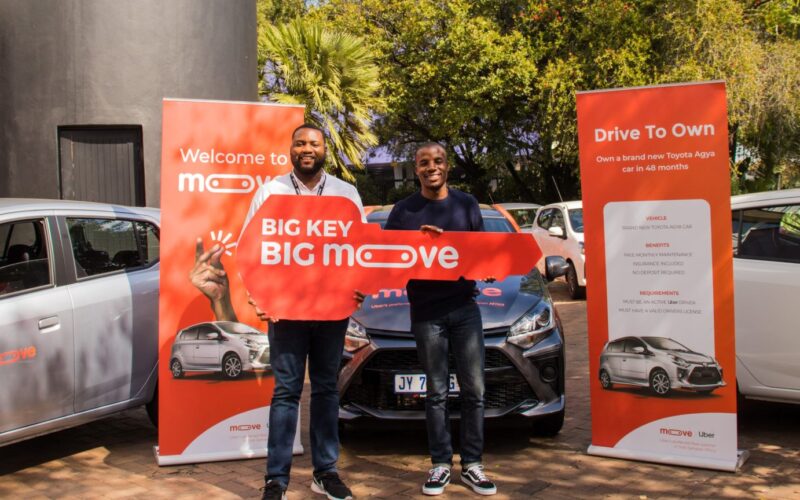
Moove has raised $250 million in a Series C round led by Abu Dhabi’s Mubadala Investment Company, pushing its valuation to $2.1 billion and confirming unicorn status for the company that started out financing cars for Lagos ride-hailing drivers. Woven Capital, Toyota’s growth fund, and Ion Pacific co-led the round, with BlueCrest Capital Management, Sona Asset Management and The Raptor Group joining as new backers alongside existing investors BlackRock, MUFG, Franklin Templeton and Uber.
The jump is steep even by African tech’s standards. Moove was valued at roughly $750 million in 2024; it now sits at $2.1 billion, a near-tripling in under two years, and the story behind that number is a company that has effectively swapped its original business model for a new one. Founded in Lagos in 2020 by Ladi Delano and Jide Odunsi with 76 vehicles, Moove built its early reputation on revenue-based vehicle financing for drivers locked out of traditional credit — a niche TechMoonshot has tracked as competitors like inDrive and Max later tried to replicate it. That model scaled fast enough to pull in a $100 million round from Uber and Mubadala in March 2024, reported at the time as one of the continent’s biggest raises of the year.
From Driver Financing to Robotaxi Infrastructure
The company now operates roughly 42,000 vehicles across 29 cities in 13 countries, employs 3,300 people, and generates $420 million in annual recurring revenue. But the pitch that just closed $250 million has almost nothing to do with gig drivers. Moove has repositioned itself as the operating layer for autonomous mobility — the company that owns, charges, services and orchestrates self-driving fleets on behalf of the platforms that build the actual autonomy software. Its flagship proof point is a partnership with Waymo, Alphabet’s robotaxi unit, managing fleet operations for Waymo’s Phoenix service and its newer Miami launch, with a London rollout planned next. The new capital will fund “Nests” — robotics-first depot sites where autonomous vehicles are charged, serviced, inspected and repaired — and Moove says it expects to grow its autonomous vehicle workforce from around 150 employees to about 500 by the end of the year, a jump of more than 220%.
For Mubadala and the Toyota-linked Woven Capital, the logic is straightforward: robotaxi operators like Waymo, Zoox and Tesla’s forthcoming fleets need someone to own, insure, maintain and dispatch thousands of physical vehicles at city scale, and building that infrastructure from scratch is slower and costlier than outsourcing it to a company that has already spent five years doing fleet operations across emerging and developed markets alike. Co-CEO Ladi Delano, confirming the round to Bloomberg, framed the shift as a natural extension of what Moove already does — managing vehicle lifecycles at scale — rather than a pivot into an unrelated business.
The Bet Investors Are Actually Making
The harder question is whether that bet pays off on the timeline investors are pricing in. Moove’s valuation increase reflects enthusiasm for the robotaxi thesis broadly, but the company’s income now depends on the pace of autonomous vehicle deployment, the terms of contracts like the Waymo partnership, and its ability to replicate fleet-operations margins across new markets — none of which Moove fully controls. The business also carries the capital intensity that has weighed on vehicle-financing fintechs before it: owning physical fleets, property and charging infrastructure requires sustained cash outlay in a way that pure software companies do not face, and Moove already took on debt in 2025 to finance vehicles for the Waymo partnership specifically. A slowdown in robotaxi rollouts, regulatory friction in any of Moove’s operating cities, or a stumble in the Waymo relationship would test how much of the $2.1 billion valuation is built on delivered revenue versus adjacent-industry optimism.
Still, the raise cements Moove among a small handful of companies that built globally relevant infrastructure starting from an African market rather than entering one, a distinction TechMoonshot’s investor coverage has flagged as increasingly rare even among the continent’s best-funded fintechs. What happens next depends less on Lagos or Nairobi than on how fast Waymo, and the robotaxi operators likely to follow it, actually scale.