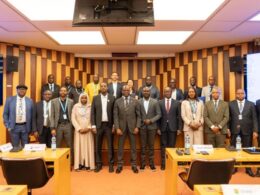
Cape Town-based Grindstone Ventures has launched a R500 million ($31.2 million) fund aimed at high-growth, technology-enabled African businesses stuck between proving commercial demand and reaching the scale that attracts institutional capital. The vehicle, led by CEO Thandiwe Maqetuka, was established in partnership with Knife Capital and Thinkroom, the two firms that co-own the Grindstone accelerator programme.
Chasing Africa’s Seed-to-Series-A Gap
The fund is targeting a first close of R150 million ($9.3 million) and plans to build a portfolio of 15 to 20 companies, investing from Seed through Series A with capacity for follow-on rounds into its strongest performers. It will focus primarily on South Africa, with selective bets elsewhere on the continent.
Maqetuka framed the thesis around what Grindstone calls Africa’s “missing middle” — startups that have demonstrated real commercial traction but remain too small for the institutional cheques typically written at Series A. “Our opportunity is not simply to provide more capital, but to identify exceptional businesses earlier, invest at a point where capital remains scarce, take meaningful ownership positions and work actively with founders to build companies capable of scaling,” she said.
The gap she is describing shows up clearly in the numbers. Of 105 African startups that raised seed capital in 2022, only 10 had closed a Series A round within 34 months, while 81 remained stuck at the early stage and 11 shut down or were acquired. Seed-stage deal volume across the continent fell from 105 rounds in 2022 to just 31 in 2024, recovering only partially to 42 in 2025. Today, roughly 4 to 5% of African startups that raise seed funding reach Series A, compared with 10 to 15% globally — a conversion rate less than half the global norm.
Building for Liquidity From Day One
Grindstone Ventures Fund I, the firm’s first vehicle, backed seven companies and helped catalyse follow-on seed investment from South African funders. Three of those portfolio companies — Locstat, Welo and AgriLogiQ — went on to raise further equity from international investors, and the fund is finalising an exit that Grindstone says will return capital to its backers.
That exit discipline is the explicit differentiator for Fund II. “We diversify at entry, allow performance to emerge and then concentrate capital behind the strongest performers,” Maqetuka said. “Paper valuations don’t return capital to investors, exits do.” Keet van Zyl, co-founder of Knife Capital, described the seed-to-Series-A transition as one of the clearest structural gaps in African venture investing, language that echoes a broader pattern already visible across the continent’s funding landscape: debt financing and strategic acquisitions have overtaken pure equity rounds as the more reliable path to returns for investors wary of markdowns on paper valuations.
An Inclusion Mandate Alongside the Return Thesis
Grindstone Ventures is pairing its financial return objectives with an explicit diversity target, aiming for at least half of its portfolio companies to be black-owned while pursuing gender-balanced representation among founders and leadership teams. The firm has separately partnered with the Mineworkers Investment Company on a female founder funding-readiness programme, which selected South African beverage startup Palé in June 2026. That combination of financial and inclusion goals places Grindstone alongside other African funds explicitly built around gender or representation mandates, such as Janngo Capital, which closed its second $78 million fund targeting gender-equal investing across the continent.
The Harder Test Is Still Ahead
Declaring an exit-first mandate is easier than delivering one. Grindstone’s own pipeline draws on a wider ecosystem that screens more than 1,000 businesses annually and puts roughly 50 through its accelerator programmes each year, which gives the firm deal flow but does not guarantee that South Africa’s thin pool of later-stage buyers and acquirers will materialise on the fund’s timeline. Fund I’s single pending exit, after backing seven companies, is a modest track record to build a second, larger fund’s credibility on. The bigger unresolved question for Grindstone, and for the “missing middle” thesis generally, is whether more capital at the Seed-to-Series-A stage actually fixes a bottleneck that is really about the scarcity of growth-stage and exit buyers further down the pipeline.
What to Watch Next
Grindstone’s ability to reach its R500 million target, not just its R150 million first close, will be an early signal of institutional appetite for this thesis. So will the terms and outcome of Fund I’s pending exit, which the firm has cited as proof of concept for the entire “paper valuations don’t return capital” pitch it is now making to a new set of investors.